★★★★★
350
☰
In Port Salerno's older waterfront and ranch homes, a dirty evaporator coil does not just cost you cooling — it chokes airflow, freezes the system solid, and strains the compressor on every cycle. Here is the chain reaction, step by step, and why regular maintenance that includes coil cleaning is what breaks it.
If you are looking into AC coil cleaning in Port Salerno, FL, there is a good chance your system has already given you a warning sign: a room that will not cool, ice on the refrigerant lines, or a unit that runs all afternoon and barely moves the thermostat. Port Salerno homes ask a lot of their air conditioning. The air off Manatee Pocket is humid and salty every day of the year, older air handlers here have often gone years without a real cleaning, and a boat-and-water lifestyle means doors opening to docks and patios, with salt and sand tracked straight through the house.
The coil is where your air actually gets cold, and it is also where a slow, expensive chain reaction starts. This page walks through that chain in order — restriction, pressure, freeze-up, strain — and what regular maintenance does to prevent every link in it.
Every bit of air your system cools has to pass through the evaporator coil — a dense grid of fins inside the air handler. When the coil is clean, air moves across it freely and picks up the cold. When dust, sand, and grime build up on those fins, they create a restriction across the coil. The air has to fight its way through a narrower, dirtier path, and that fight shows up as higher static pressure in the system.
Higher static pressure means the blower has to work harder to move the same amount of air — and it loses. Airflow through the system drops. Less air across the coil means less heat absorbed from your home on every pass, and that is where the next, worse problem begins.
An evaporator coil needs steady airflow to stay at the right temperature. Starve it of air and the coil gets too cold — cold enough that the moisture it pulls from our humid Pocket air stops draining away as water and starts freezing onto the coil instead. Ice builds on the coil and can climb onto the refrigerant lines. That ice is itself another restriction, so airflow drops further, the coil gets colder still, and the system spirals until it is running hard and cooling almost nothing.
If you find ice on your coil or lines, the right move is simple: turn the system off, let it thaw completely, and do not just restart it and hope. The freeze-up is a symptom. Until the dirty coil underneath it is cleaned, the ice will be back — usually on the next hot afternoon, when you need the system most.
While all of this is happening inside the air handler, what you feel in the house is simpler: cooling suffers. Rooms stay warm. The thermostat sits a few degrees above where you set it. Runtimes stretch — the system runs longer and longer cycles trying to catch up, and your electric bill climbs for comfort you are not actually getting.
The real damage is being done to the compressor. The compressor is the heart of the system and the most expensive component in it. A restricted, freezing coil forces it to run longer, hotter, and under more strain on every single cycle. Energy is wasted, efficiency falls off, and the system's service life gets shorter. A dirty coil never stays a small problem — it quietly taxes the whole system until something expensive gives out.
Port Salerno is harder on coils than most of Martin County, for three reasons. First, the waterfront air: an air handler here is always working in humid, salt-carrying air off Manatee Pocket, and a damp coil collects and holds grime faster than a dry one. Second, age: many Port Salerno air handlers are older units in 1970s through 1990s homes, and when we open them we regularly find coils that plainly have not been cleaned in years — sometimes not ever. Third, the lifestyle: fishing and boating households track in sand and salt, doors stand open to the dock and the patio, and all of that airborne grit ends up on the filter — and whatever gets past the filter ends up on the coil.
That combination is the classic Port Salerno freeze-up story — a hot weekend, the house full, the thermostat set low, and a coil that cannot breathe freezing under the load. Regular maintenance is what keeps that weekend from happening.
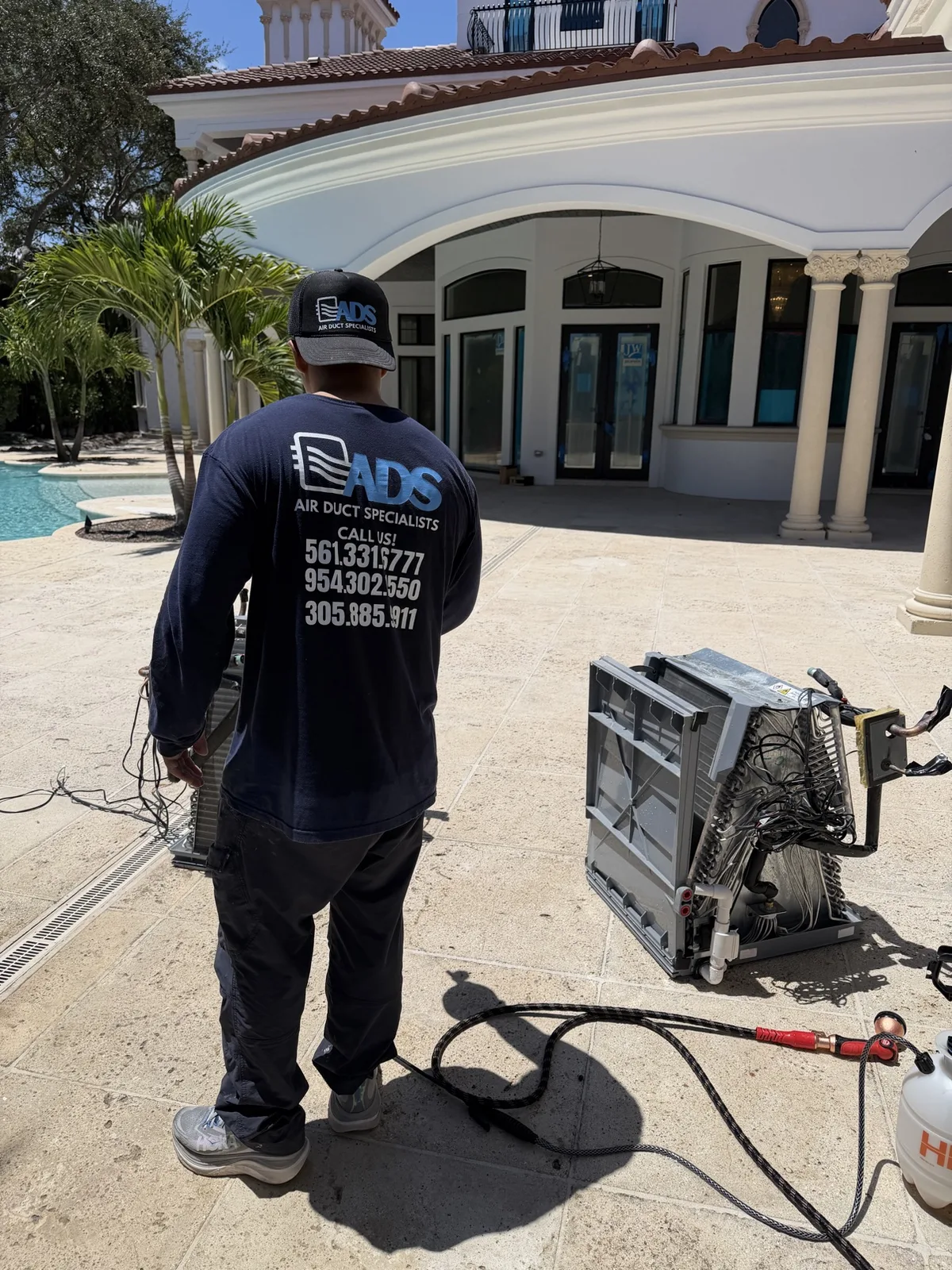
Proper coil cleaning is part of a real maintenance visit, not a spray-and-go. When our techs service a Port Salerno system, the visit covers:
That is the whole point of regular AC maintenance that includes evaporator coil cleaning: it prevents the chain reaction at the first link. Clean coil, normal static pressure, full airflow, no freeze-up, no compressor strain — and a system that holds its efficiency and lasts the years it was built to last.
We will not invent a flat price for your home sight unseen — the honest figure depends on the size of your system and how the coil has to be accessed, and older Port Salerno air handlers are not all equally easy to get to. What we can tell you plainly: coil cleaning is handled as part of regular maintenance, and we give you a free estimate with exact pricing before any work begins. No hidden fees, no upselling, ever — what we quote is what you pay.
Air Duct Specialists LLC serves Port Salerno and all of Martin County. Licensed CAC1825166. Fully insured. 350 five-star reviews. Same-day service, 7 days a week, 7am–11pm. Free estimates — no hidden fees, no upselling.
📞 (561) 331-6777 — Treasure CoastWhat happens if you never clean your evaporator coil?
Buildup on the coil restricts airflow and raises static pressure, so less air moves through the system. The coil then gets too cold and can freeze over with ice, cooling drops off, rooms stay warm, runtimes get longer, and the compressor strains under the extra load. Left alone long enough, that strain wastes energy on every cycle and shortens the life of the whole system.
Can a dirty coil really make my AC freeze up?
Yes. When dirt chokes airflow across the coil, the coil temperature falls below freezing and moisture in the air turns to ice on the coil and refrigerant lines. Once ice forms, airflow drops even further and cooling can stop almost completely. If you see ice, turn the system off and let it thaw, then have the coil inspected and cleaned — the freeze-up will keep coming back until the restriction is removed.
How often should coils be cleaned in Port Salerno?
For most Port Salerno homes, having the evaporator coil inspected and cleaned as part of regular AC maintenance once a year is the right rhythm. Waterfront homes on Manatee Pocket load coils faster because the air handler is constantly pulling in humid, salty air, and older air handlers that have not been serviced in years should be checked now rather than waiting for a freeze-up.
Is coil cleaning part of regular AC maintenance?
It should be. A real maintenance visit includes inspecting the evaporator coil and cleaning it when it needs it, along with the filter, drain line, blower, and electrical checks. Coil cleaning is not an exotic add-on — it is one of the core jobs that keeps a system efficient, prevents freeze-ups, and protects the compressor, which is the most expensive part of your system to replace.
How much does AC coil cleaning cost in Port Salerno, FL?
We do not quote a flat coil-cleaning price sight unseen, because the honest figure depends on the size of the system and how the coil has to be accessed. Coil cleaning is handled as part of a maintenance visit, and we give you a free estimate with exact pricing before any work begins — no hidden fees, and what we quote is what you pay.
Is Air Duct Specialists licensed and insured?
Yes. Air Duct Specialists LLC is a licensed Florida air conditioning contractor, license CAC1825166, and is fully insured. We serve Port Salerno and Martin County 7 days a week, 7am to 11pm, with 350 five-star Google reviews. You can verify the license through the Florida DBPR before any work begins.