★★★★★
350
☰
In Davie, the complaint is almost always the same room: the back bedroom that has never cooled right, no matter what the thermostat says. These are ranch homes — single-story, low-pitch roofs, shallow attics you can barely crawl — and the duct run to that far room is the longest one in the house. If it leaks along the way, that room gets what is left over.
Air duct leaks in Davie, FL show up differently than they do in a newer two-story home, because the houses themselves are different. Much of Davie — the older neighborhoods off Davie Road, Orange Drive, and Griffin Road, and the western and equestrian properties further out — was built in the 1970s, 1980s, and 1990s as single-story ranch homes. The air handler sits at one end, the bedrooms sit at the other, and one long trunk line carries cooled air the full length of the house through a low, hot attic.
That layout leaves no margin for leaks. The U.S. Department of Energy puts typical duct losses at 20 to 30% of conditioned air, and older attic systems can lose more. In a Davie ranch, that loss concentrates on the far rooms. The living room near the handler feels fine. The back bedroom, fed by the longest and oldest run, stays three, four, even five degrees warmer. Homeowners blame the AC unit — it was rarely the problem.
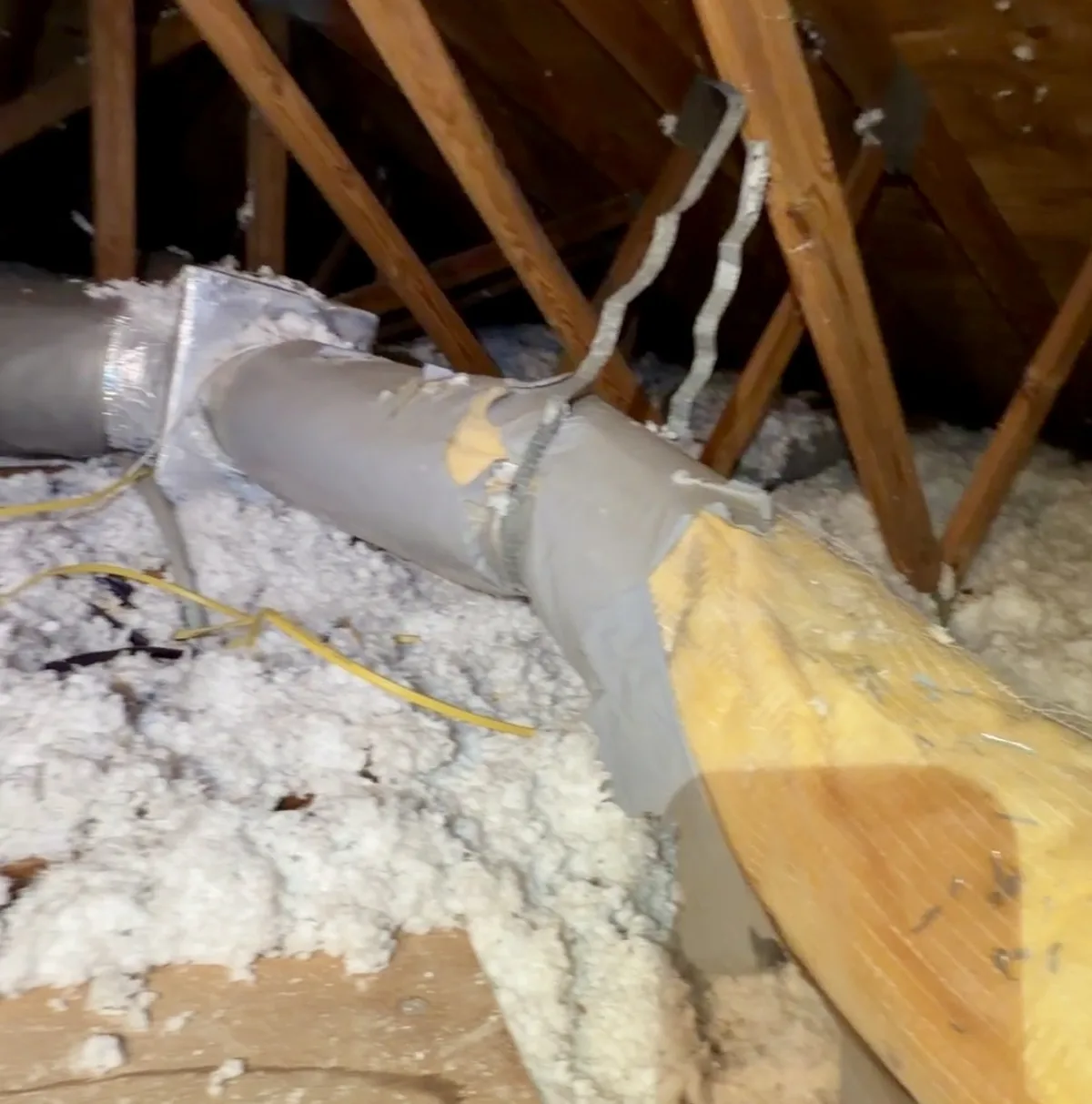
A supply leak pushes cooled air out of the system before it reaches a vent — through a separated joint, a tear in the flex, or a takeoff that has pulled loose from the trunk. A return leak does the opposite: it draws hot attic air in on the way back to the blower, along with dust and insulation fibers. Most older Davie systems have some of both.
Then there is the addition problem, and Davie has plenty of it. A den, converted garage, or enclosed patio added years ago was often tied straight into the existing trunk line — a line that was already leaking. The addition never cooled well from day one, because it was connected to a system that could not feed the rooms it already had. Fix the trunk first, and the addition often comes back with it.
The causes we find in Davie attics are consistent, and most trace back to age and heat:
None of this means the whole system is scrap. It means the diagnosis has to start in the attic, not at the thermostat — and in a Davie ranch, getting a tech who will actually crawl that attic is half the battle.
Leaks announce themselves from inside the house long before anyone opens the attic hatch:
Why not ignore it? Because the leak does not stay put. Escaping cold air feeds condensation in a humid attic, return leaks keep feeding dust across the coil, and every summer the brittle material gets worse. A sealing job this year can become a replacement job in a few years.
If you go up, go early. A Davie attic is workable at 7am and punishing by noon. Set the fan to "on," bring a strong light, and stay on the joists or decking — in these low attics you will be crawling, not walking. Run your hand slowly along each joint and connection you can reach. Supply leaks feel like a cool jet; return leaks feel like suction pulling at your palm. A strip of tissue held near a joint makes small leaks visible.
Look as much as you feel: sagging runs, dust streaks fanning out from a joint, tape peeling or hanging, and insulation that is torn or missing. If the far half of the attic is a belly-crawl you are not comfortable making, stop there — that is exactly where a professional leakage test earns its keep, measuring the loss without anyone having to reach every joint.
Good ductwork with bad joints gets sealed, and the sealant that holds is UL 181M code-standards duct sealant — brushed on thick over every joint, takeoff, and connection, with fiberglass mesh worked into it over wider gaps. It cures flexible, fills the irregular gaps that are everywhere in older flex systems, and does not peel the way tape does. Sagging runs get re-supported at proper spacing so the sealed joints are not stressed open again.
Bad ductwork gets a different conversation, and we will have it honestly. Flex that has gone brittle, torn in several places, or lost its insulation value cannot be sealed back to health — UL 181M code-standards duct sealant on crumbling material is money spent twice. In many Davie ranches the right call is a split one: replace the failed runs, seal and re-support the sound ones, and re-insulate where the old wrap has failed. You get a system that delivers its air again, without paying to redo sections that still have years left in them.
Sealing sound ductwork is priced by the size of the system and how much of it we can reach, and it is one of the better paybacks in home repair — the improvement shows up in the far rooms and in the next electric bill. Where insulation has failed but the duct itself is sound, re-insulation is priced on the same free estimate. Where the ductwork itself is done, a full duct replacement is priced on a free on-site estimate based on home sizing, layout, and materials required.
Every job starts with a free on-site estimate, so you see the exact figure for your home before any work begins — what we quote is what you pay, with no hidden fees and no upselling. If a simple sealing job is all your system needs, that is what we will tell you.
Air Duct Specialists LLC serves Davie and all of Broward County. Licensed CAC1825166. Fully insured. 350 five-star reviews. Same-day service, 7 days a week, 7am–11pm. Free estimates — what we quote is what you pay.
📞 (954) 302-1550 — BrowardWhy does the back bedroom in my Davie ranch home never cool down?
In most Davie ranch homes, the back bedroom sits at the end of the longest duct run in the house. If that run is leaking at its joints, sagging between hangers, or torn, the room loses cooled air the whole way across a shallow, hot attic. By the time the air arrives, there is not enough of it left — and it is warmer than it should be. Sealing or replacing that branch is usually what finally fixes the room.
What are the signs of leaking air ducts?
One or two rooms that are always warmer than the rest, weak airflow from the far vents, a system that runs and runs without catching up, electric bills creeping up, dust building around registers, and a faint hiss near a duct joint. A leak follows a pattern: the same branch, the same rooms, every day and at every thermostat setting.
Can I check for duct leaks myself?
Yes, for the obvious ones. Set the fan to on, go into the attic early in the morning before it heats up, and run your hand along joints and connections — a supply leak feels like a cool jet, a return leak feels like suction. A strip of tissue held near a joint will flutter where air is escaping. Look for sagging flex, peeling tape, dust streaks, and sections that have pulled loose.
How do you seal leaking ducts?
Accessible joints are sealed with UL 181M code-standards duct sealant, brushed on thick and reinforced with fiberglass mesh over larger gaps. It stays flexible as it cures and holds where ordinary cloth duct tape fails. Torn or collapsed sections are cut out and replaced rather than patched, and failed insulation is renewed so the sealed duct does not keep losing cooling to attic heat.
When is sealing not enough and the ducts need replacing?
Sealing fixes joints and connections. It does not fix flex duct that has gone brittle, delaminated, or torn in multiple places, or insulation that has lost its value after decades in a hot attic. If the material itself is failing across the system, replacement is the honest answer — sealing good joints on bad duct just moves the problem to the next weak spot.
Do leaky ducts affect indoor air quality?
Yes, especially on the return side. A return leak pulls hot attic air — dust, insulation fibers, and humidity — into the system before the air is filtered and cooled, then delivers it to your rooms. Homeowners often notice it as dust that comes back days after cleaning and a house that feels more humid than the thermostat suggests it should.
Are you licensed and insured?
Yes — Air Duct Specialists LLC is a licensed Florida air conditioning contractor, license CAC1825166, and fully insured. Our own certified technicians do the work, never subcontractors, and you can verify the license through the Florida DBPR before we start.