★★★★★
350
☰
Downstairs feels fine, the upstairs bedrooms never catch up, and the house feels muggy even when the thermostat says it shouldn't. In Doral's townhomes and gated communities, that pattern usually isn't the air conditioner giving up. It's the ductwork — squeezed through shallow attics, soffits, and chases between floors — leaking the air you already paid to cool before it reaches the rooms.
Air duct leaks in Doral, FL show up differently than they do in a sprawling single-family house, because most of Doral isn't built that way. This is a city of master-planned, gated communities — Doral Isles, Doral Park, and block after block of townhome and villa communities built from the 1990s through the 2010s. In those homes the ducts don't get a wide-open attic. They get threaded through shallow attic space, dropped soffits, and narrow chases between floors — and every bend and taped joint in that tight path is a place air can escape.
The U.S. Department of Energy estimates the typical home loses 20 to 30% of its conditioned air through duct leaks, gaps, and deteriorated insulation — up to 40% in older systems. In a Doral townhome, that lost air pours into a wall chase or soffit cavity you can't see, while the room at the end of the run gets whatever is left over.
Builder-installed flex duct is the starting point. Production builders ran flexible duct through whatever space the floor plan allowed, connected it with tape, and moved on. That tape was never a permanent seal. Fifteen to thirty summers later — in attics that hit 130 to 150 degrees — the adhesive has dried out, the tape has peeled away, and joints have worked loose as the framing settles.
Townhome layouts make it worse. A two-story townhouse needs long vertical runs inside chases to feed the second floor, plus horizontal runs pinched into soffits above hallways and closets. More turns mean more connections, and more connections mean more leak points. Because so much of the system is boxed in behind drywall, a leak can run for years unseen — the only evidence is a warm bedroom and a climbing electric bill.
HOA living adds one more wrinkle: in many Doral communities the association handles the exterior and roofline, but the ductwork inside your walls and attic is yours — and nobody is inspecting it for you. If it hasn't been looked at since the home was built, it hasn't been looked at at all.
A supply-side leak pushes conditioned air out on its way to a room. The vent downstream delivers a weak, lukewarm trickle, and that room — usually the far upstairs bedroom — never reaches the set temperature. A return-side leak pulls air in instead, drawing hot attic air into the system on its way back to the blower.
The return leak is the one Doral homeowners feel most. That attic air isn't just hot, it's saturated. Doral sits inland, west of the airport, with no sea breeze cutting the humidity, so a return leak loads the system with moisture the coil often can't keep up with. The result is the classic complaint: the thermostat reads 74, but the house feels clammy and the system runs and runs without the home ever feeling dry. That same leak also drags attic dust and insulation fibers into the air your family breathes.
Duct leaks announce themselves quietly:
One caution: a closed damper, furniture over a register, or heavy afternoon sun can imitate a leak. The tell is consistency. Those problems come and go. A leak hits the same rooms, the same way, every single day.
Start in the attic, early in the morning before it heats up. Set the fan to "on," bring a light, and work along the ductwork you can reach. Run your hand past each joint at the plenum and air handler — a supply leak feels like a cool jet, a return leak like suction. A strip of tissue held near a seam will flutter where air is escaping. Look, too, for tape hanging loose, dust streaks at a joint, and takeoffs pulled partly off their collars.
That covers the attic — not the chases and soffits, where much of a Doral townhome's system lives. For those runs, a professional duct leakage test is the honest answer: every register is sealed, a calibrated fan pressurizes the system, and the airflow needed to hold that pressure is the total leakage, measured in CFM. You get a real number for the whole system, hidden sections included.
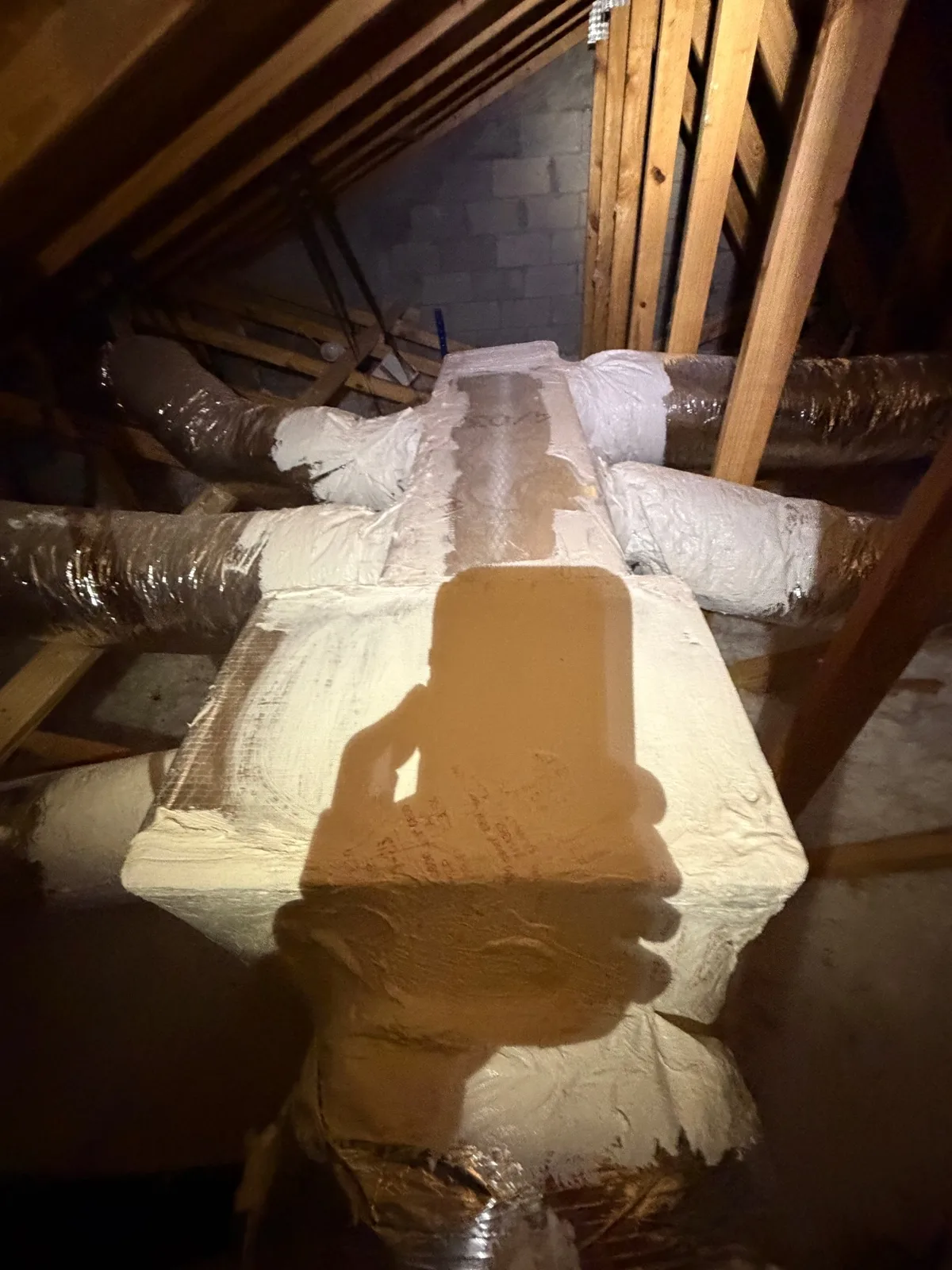
The repair is UL 181M code-standards duct sealant — a thick, brush-on sealant that fills the irregular gaps flex duct joints have, and stays flexible as it cures instead of cracking or peeling. Gaps up to about a quarter inch take UL 181M code-standards duct sealant alone; wider gaps get fiberglass mesh pressed into a first coat and sealed over with a second. Smooth metal seams take UL 181 foil tape. Ordinary cloth duct tape never goes back on a duct — the product already failing in your attic is not the fix.
The work starts where leaks concentrate: the air handler connections and the plenum, then outward through every reachable elbow, takeoff, and joint. Where the old insulation has torn or thinned, it gets addressed too, because a sealed duct in failed insulation still bleeds cooling into a hot attic. Leaks inside walls and chases are sealed with aerosol sealant carried through the pressurized system, coating the gaps from the inside.
This matters beyond the electric bill. A joint leaking cold air into a humid chase creates exactly the cool, damp pocket where condensation forms — which is why code-compliant sealing is a required service when ducts are sweating, condensing, or carrying moisture, not an optional extra. Seal the leak and you remove the moisture problem at its source.
Sealing is priced on the size of the system and how much of it can be reached, and it's one of the better paybacks in home repair — the improvement shows up in comfort right away and in the next electric bill. We give you the exact figure with a free on-site estimate, and what we quote is what you pay. No hidden fees, no upselling — ever.
Straight talk on the limits, though: sealing fixes joints and connections. It does not rescue flex duct that is torn, crushed where it was squeezed through a too-tight soffit, kinked at a hard bend, or so old its insulation has lost its value — all common in Doral's 1990s and 2000s townhome stock. When the duct material itself is the problem, the honest options are duct re-insulation, quoted exactly on a free on-site estimate, or a full duct replacement, quoted exactly on a free on-site estimate for an average smaller residential home, varying on home sizing, layout, and materials required. If sealing will do the job, we'll tell you that instead.
Air Duct Specialists LLC serves Doral and all of Miami-Dade County. Licensed CAC1825166. Fully insured. 350 five-star reviews. Same-day service, 7 days a week, 7am–11pm. Free estimates — what we quote is what you pay.
📞 (305) 885-9911 — Miami-DadeWhy are duct leaks so common in Doral townhomes and gated communities?
Most Doral townhomes and villas were built in the 1990s through the 2010s with builder-installed flex duct squeezed through shallow attics, soffits, and chases between floors. Those runs have more bends and joints than a typical single-family layout, and the original taped connections are now 15 to 30 years old — dried out, peeling, and pulling apart in the heat. Tight access makes small leaks easy to miss for years.
What are the signs my air ducts are leaking?
One room or one floor that never matches the thermostat, weak airflow from the far vents, a muggy or clammy feeling even when the temperature looks right, bills that climb without a change in habits, dust streaks around registers, and a system that runs longer than it used to. A leak hits the same branch consistently, in every season and at every setting.
How are duct leaks found in a two-story townhome?
Start with what is reachable: run the fan, feel along attic joints and plenum connections for escaping air, and hold a tissue strip near seams to watch for flutter. Look for peeling tape, dust streaks, and disconnected takeoffs. For runs hidden in soffits and floor chases, a professional duct leakage test pressurizes the system and measures the loss in CFM, so hidden leaks show up in the number even when you cannot see them.
How are leaking air ducts sealed?
Reachable joints are sealed with UL 181M code-standards duct sealant — a brush-on sealant that stays flexible as it cures — reinforced with fiberglass mesh on larger gaps, with UL 181 foil tape on smooth metal seams. Ordinary cloth duct tape is not a duct repair: attic heat and pressure cycles loosen its adhesive until it peels. Leaks buried inside walls and chases are sealed with aerosol sealant applied by a professional.
Can a return leak make my Doral home feel muggy?
Yes — and in Doral it is one of the most common causes. A return-side leak pulls hot, humid attic air into the system before the coil can properly dry it, so the house feels clammy even at the right temperature. Doral sits inland, west of the airport, with no ocean breeze to take the edge off, so that extra humidity load shows up fast in how the home feels.
Are you licensed and insured?
Yes — Air Duct Specialists LLC is a licensed Florida air conditioning contractor, license CAC1825166, and fully insured. You, your landlord, or your property manager can verify the license through the Florida DBPR before any work begins.