★★★★★
350
☰
Palm City is a family town of big single-family homes — Martin Downs, Evergreen, and Crane Creek, plus the newer developments off High Meadow — and big homes mean big attics, long duct runs, and often two full AC systems. When air duct leaks open up in Palm City, FL, cooled air escapes into a scorching attic before it ever reaches the bedrooms, and the bills show it first.
Air duct leaks in Palm City, FL do not announce themselves with a puddle or an alarm. You get one room that is always warm, an FPL bill that keeps climbing, and dust that comes back days after you cleaned. Palm City families run their air conditioning hard, almost year-round, so even a modest leak runs for thousands of hours a year. The U.S. Department of Energy estimates the typical home loses 20 to 30% of its conditioned air through duct leaks and gaps — cooling you already paid for, dumped into an attic that hits 130 to 150 degrees in summer.
The local pattern is consistent. Martin Downs, Evergreen, and Crane Creek are full of well-built family estates now 15 to 25 years old — right at the age where original builder-grade sealing fails. Newer homes off High Meadow have larger footprints and longer runs to the far bedrooms, so one leaking junction can starve a whole side of the house. Two-system houses double everything: two plenums, twice the joints, twice the places air can escape.
A supply-side leak is straightforward: cooled air escapes through a gap at a joint or a torn section of flex before it reaches the vent, and the room at the end of that run gets whatever is left. The system runs longer to make up the difference, and your bill absorbs it.
A return-side leak is worse in Florida. Returns work under suction, so a gap pulls air in — hot attic air, dust, and insulation fibers, loaded with humidity. Indoor humidity climbs, rooms feel clammy even when the thermostat reads right, and mold gets steady moisture at the coil and registers. When a Palm City home has both high bills and a humidity complaint, leaky returns are where we look first.
Leaks are consistent, and that consistency is the tell. Watch for:
One caution: a closed damper, furniture over a vent, or a dirty filter can imitate a leak for a day. A real leak is there every day, on the same branch, until someone seals it.
Attic heat cooking the connections is cause number one. A Palm City attic spends months at 130 to 150 degrees, and every joint in it bakes. Tape adhesive dries and lets go, sealant from the original build gets brittle and cracks, and plastic flex connections soften, shift, and open up. Heat alone will undo a duct system given enough summers — and these homes have had plenty.
Aging flex duct is next. The flex runs in 15- to 25-year-old developments have spent their whole lives in that heat. Inner liners get brittle, outer jackets split, and sections sag or get crushed when other trades work in the attic. A crushed or torn section does not just leak — it chokes airflow to that branch.
Original builder-grade sealing failing ties it together. Production sealing was done fast: joints taped or lightly coated, connections that were adequate the day the house passed inspection. Fifteen-plus years of heat cycles, house settling, and system vibration later, those joints are the weakest points in the system. Most older Palm City homes do not have one leak — they have several, at several joints, on both systems.
You can find the worst leaks with no tools. Set the fan to "on," go into the attic early in the morning before it heats up, and bring a flashlight. Pass your hand over every seam, elbow, and connection at the plenum and air handler. Escaping supply air feels like a cool jet; a return leak pulls at your palm. A strip of tissue held near a joint will flutter or get drawn in at a leak. Look for peeling tape, dust streaks, and disconnected sections.
For a measured answer, a professional duct leakage test pressurizes the system with a calibrated fan and reports the total leakage in CFM. It catches leaks inside walls and chases, and gives you a before-and-after number, so a sealing job can be verified instead of taken on faith.
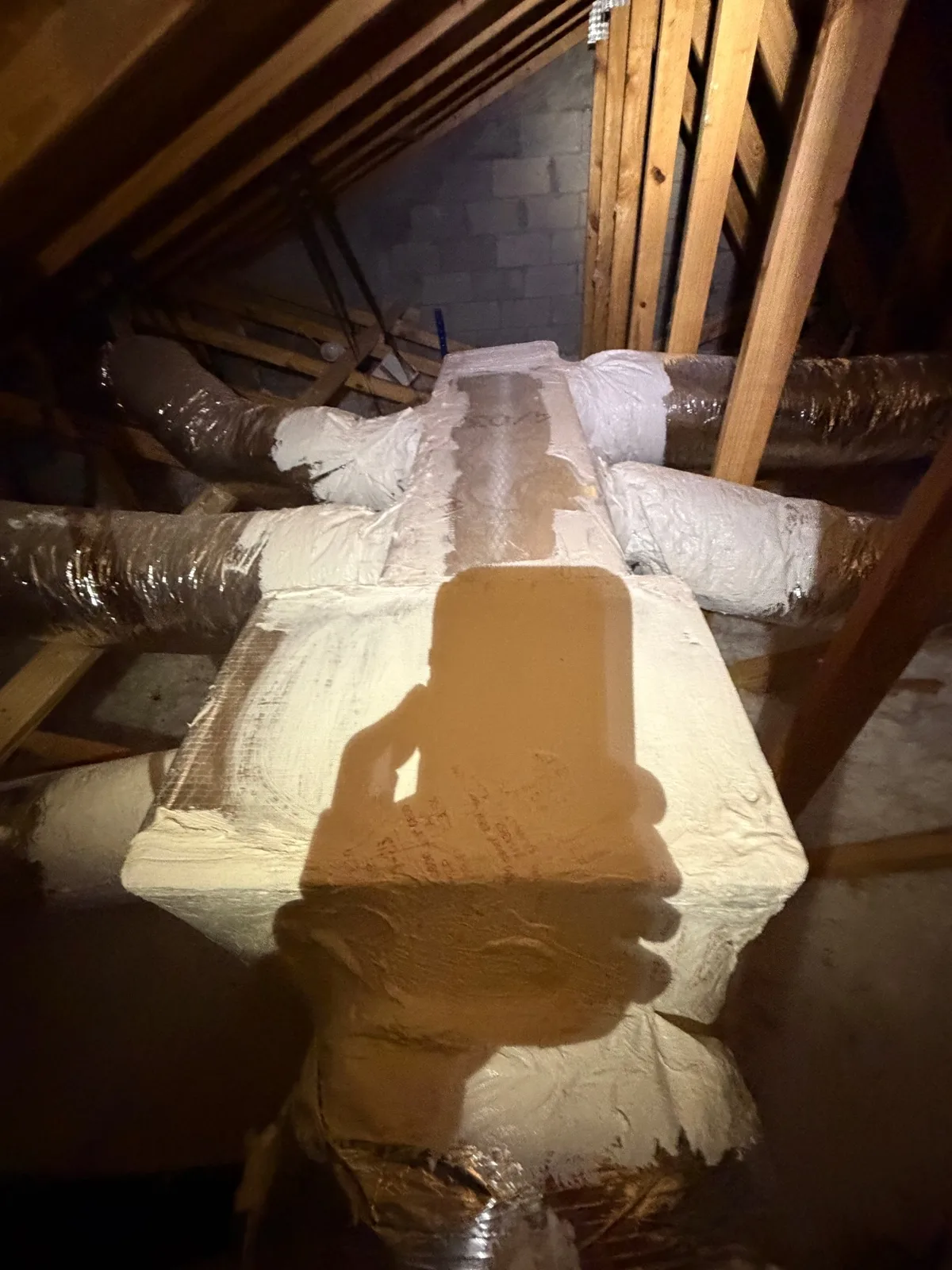
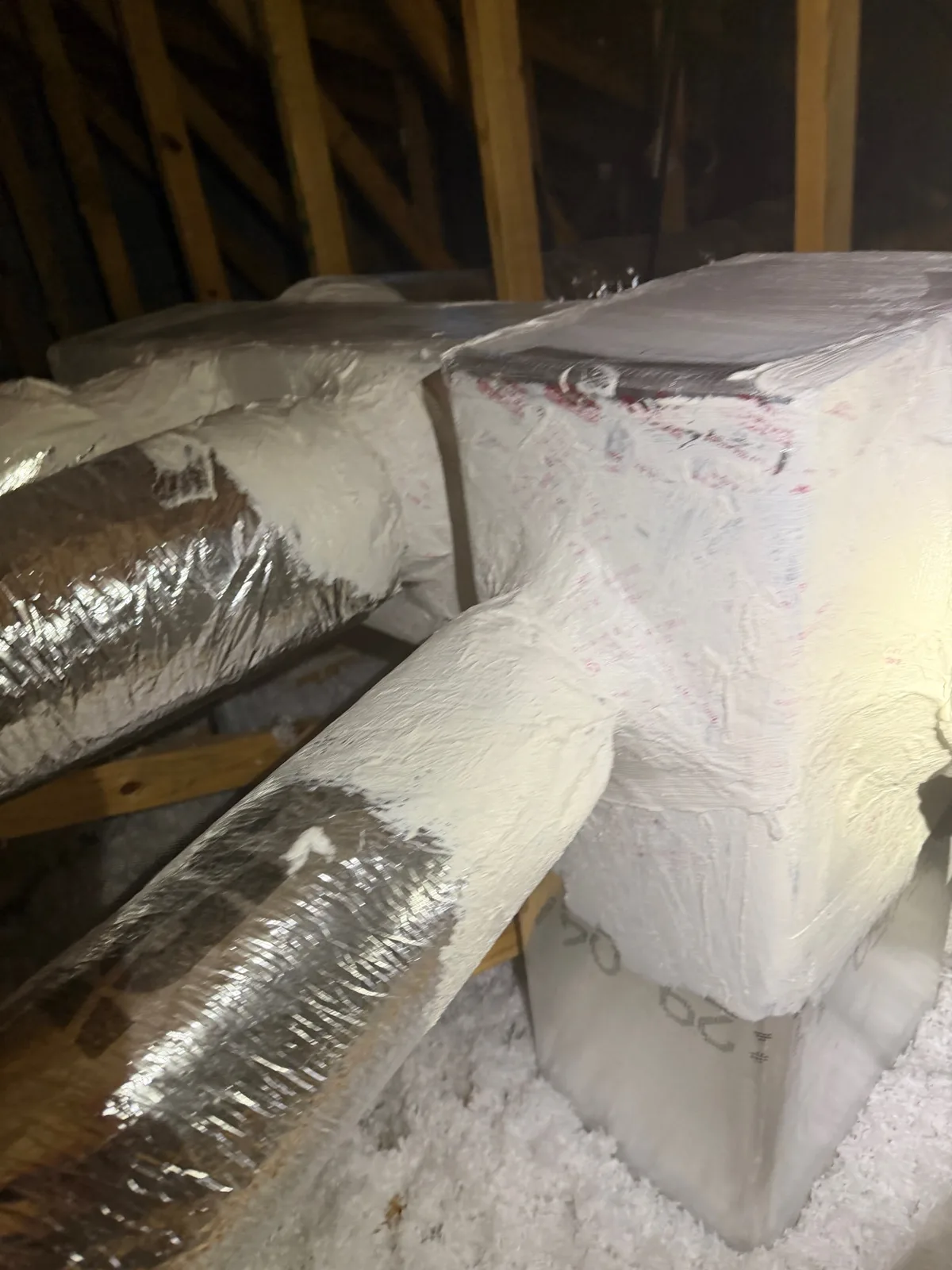
The repair that holds is UL 181M code-standards duct sealant — a thick, brush-on sealant that fills irregular gaps, stays flexible as it cures, and bonds to both metal and flex. Gaps wider than a quarter inch get fiberglass mesh pressed into the wet sealant and a second coat over the top. Smooth metal seams take UL 181 foil tape. What does not hold is ordinary cloth duct tape: its adhesive gives up under attic heat and pressure cycles, often within a season, which is exactly how a "fixed" leak comes back.
The work starts where leaks concentrate — the air handler connections and the plenum — then follows every takeoff, elbow, and junction outward, returns included. On a two-system home we do both systems in the same visit. Where insulation around a sealed joint has failed, it gets restored too: a sealed duct in a bare jacket still loses cooling to attic heat.
While we are up there, we also check the coil and blower. A system that ran for years with leaky returns has been pulling attic dust across its coil the whole time, and sealing without looking leaves half the problem in place.
Sealing is priced on the size of the system and how much of it can be reached, and the honest way to get a number is a free on-site estimate — what we quote is what you pay, with no hidden fees. For most Palm City homes with sound ductwork, sealing is the lowest-cost fix with the fastest payback, because the savings start with the next FPL bill.
But sealing has a limit, and we will name it when we see it. Sealed to UL 181M code standards fixes joints and seams; it does not fix flex duct that is torn, crushed, or so old its insulation has lost its value. When the ducts themselves are at the end, the honest options are re-insulation or a full duct replacement, both priced on a free on-site estimate based on home sizing, layout, and materials required. Most average homes take at most 1–2 days for a full replacement. If your ducts can be sealed and saved, that is what we will recommend — no upselling, ever.
Air Duct Specialists LLC serves Palm City and Martin County. Licensed CAC1825166. Fully insured. 350 five-star reviews. Service 7 days a week, 7am–11pm. Free estimates — what we quote is what you pay.
📞 (561) 331-6777What are the signs of air duct leaks in a Palm City home?
One room that is always warmer than the rest, weak airflow at the far vents, FPL bills rising with no change in habits, dust building up quickly around registers, and a system that runs longer than it used to. A leak follows a pattern: the same branch underperforms at every thermostat setting, in every season, until it is sealed.
Why do ducts in Martin Downs and Crane Creek start leaking?
Most of these homes are now 15 to 25 years old, and the original builder-grade sealing at the joints was never built to last that long in a Florida attic. Summer attic heat cooks the connections, the sealant and tape dry out and let go, and aging flex duct gets brittle. Once one joint opens, pressure and vibration work on the next one.
How are leaking air ducts sealed?
Accessible joints are sealed to UL 181M code standards with UL 181M code-standards duct sealant, a brush-on sealant that stays flexible and fills irregular gaps, reinforced with fiberglass mesh on larger openings. Smooth metal seams take UL 181 foil tape. Ordinary cloth duct tape is not the fix — attic heat loosens its adhesive until it peels, often within a season.
Can leaky ducts raise my FPL bill and cause humidity problems?
Yes. A supply leak dumps cooled air you already paid for into a hot attic, so the system runs longer. A return leak does the opposite, pulling hot, humid attic air into the system. That raises indoor humidity, makes rooms feel clammy, pushes the electric bill up, and gives mold what it needs around the coil and registers.
When does sealing stop being enough and replacement make sense?
Sealing fixes joints and seams on ductwork that is otherwise sound. If flex duct is torn, crushed, or so old its insulation has lost its value, sealing will not restore it. In that case re-insulation or a full replacement is the honest answer. A full replacement for an average smaller residential home is quoted on a free on-site estimate, varying on home sizing, layout, and materials required.
Do you serve Palm City, and are you licensed and insured?
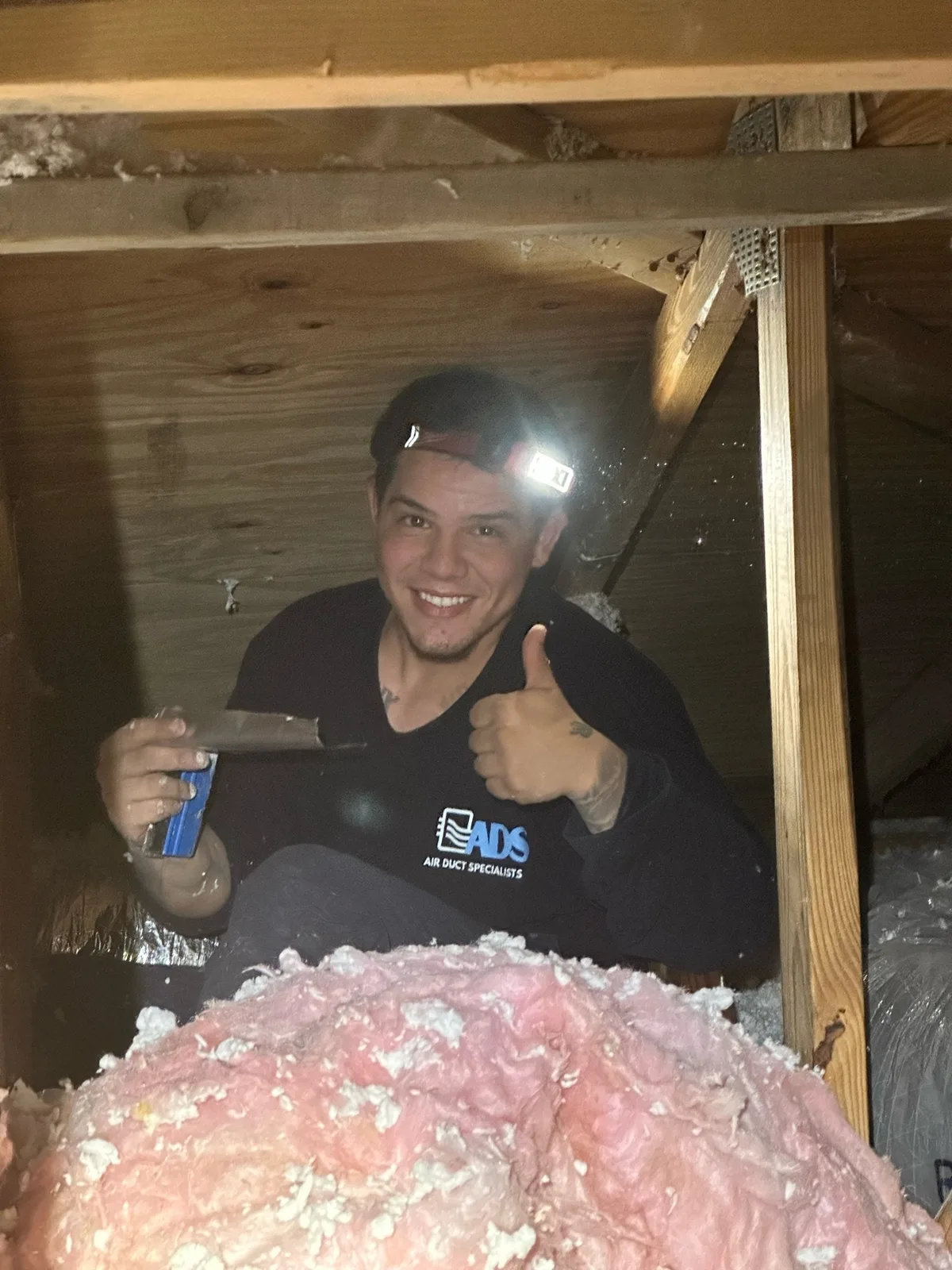
Yes — Air Duct Specialists LLC serves Palm City and Martin County, with service 7 days a week, 7am to 11pm, and free estimates. We are a licensed Florida air conditioning contractor, license CAC1825166, fully insured, with 350 five-star Google reviews. Our certified techs — never subcontractors — do the work.