★★★★★
350
☰
Your air conditioner is running longer, the far bedroom never quite cools down, and the electric bill keeps climbing — but the equipment itself checks out fine. In Weston, where so many homes run long duct runs through hot attics, the problem is often not the AC at all. It is the ductwork between the equipment and the rooms, quietly leaking a quarter or more of the air you already paid to cool.
Air duct leaks in Weston, FL are one of the most common — and most overlooked — problems we find in Broward homes. The U.S. Department of Energy estimates the typical home loses 20 to 30% of its conditioned air through duct leaks, gaps, and deteriorated insulation, and in older attic systems the loss can reach 40%. That is air you already paid to cool, escaping into a 130- to 150-degree attic before it ever reaches a vent. You are paying to cool the attic. The rooms get whatever is left.
Weston is a prime candidate for this problem. Much of the housing stock — Bonaventure, Weston Hills, the communities along Weston Road — was built in the 1980s through the 2000s with long flex-duct runs through unconditioned attics. Twenty-plus years of summer heat, tape that dries out and peels, and joints that loosen as the house settles add up to a system that leaks at every connection.
There are two kinds of leaks, and they hurt you in different ways. A supply-side leak pushes conditioned air out: the air you paid to cool escapes through a gap at a joint, a torn section of flex, or a disconnected takeoff, and the room downstream gets a weak, warm trickle instead of a full supply. A return-side leak works in reverse — it pulls air in, drawing hot, dusty attic air straight into the airstream on its way back to the blower.
The return-side leak costs you twice: it wastes energy, and it drags dust, insulation fibers, and humidity directly into the rooms — which is why a home with leaky returns often has both high bills and dust that never settles. Even a two-inch gap in a supply duct can cut system performance by more than 20%, and a single crushed section of flex duct can cut airflow by 40 to 60%.
Most duct problems start subtly. Here is what to watch for:
One caution: a closed damper, a blocked vent, or a room with more window exposure can mimic a leak. The difference is the pattern — a leak hits the same branch every time, at every setting. If the far bedroom is always the warm one, the ducts are the first place to look, not the thermostat.
You can find the biggest leaks yourself, without equipment, before you decide on a paid test. Turn the system fan to "on" so air is moving, then work along the accessible ducts in the attic — Weston attics are hot, so go early in the morning and bring a light. Run your hand slowly along joints, seams, and the connections at the air handler and the plenum. A supply leak feels like a jet of conditioned air; a return leak feels like suction. Hold a strip of tissue or a lit incense stick near each joint — if the tissue flutters or the smoke moves, you have found a leak.
For a precise number, a professional duct leakage test — a duct blaster test — seals every register and return, connects a calibrated fan to the system, and pressurizes the ducts to a standard 25 pascals. The airflow needed to hold that pressure is the leakage, reported in CFM. It finds the leaks you cannot reach by hand, including the ones buried inside walls and ceilings. A standalone test is quoted exactly on a free on-site estimate depending on home size and access.
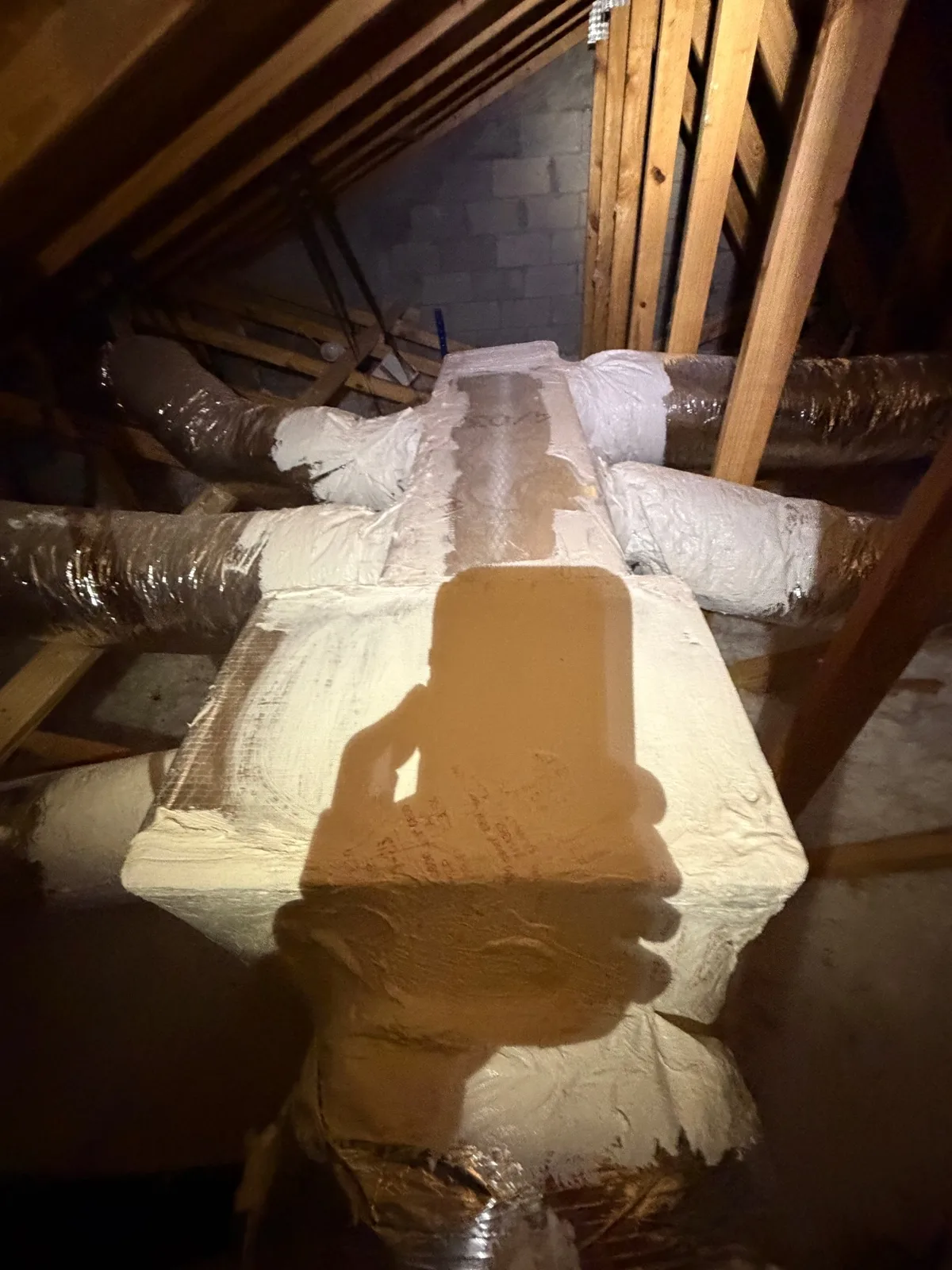
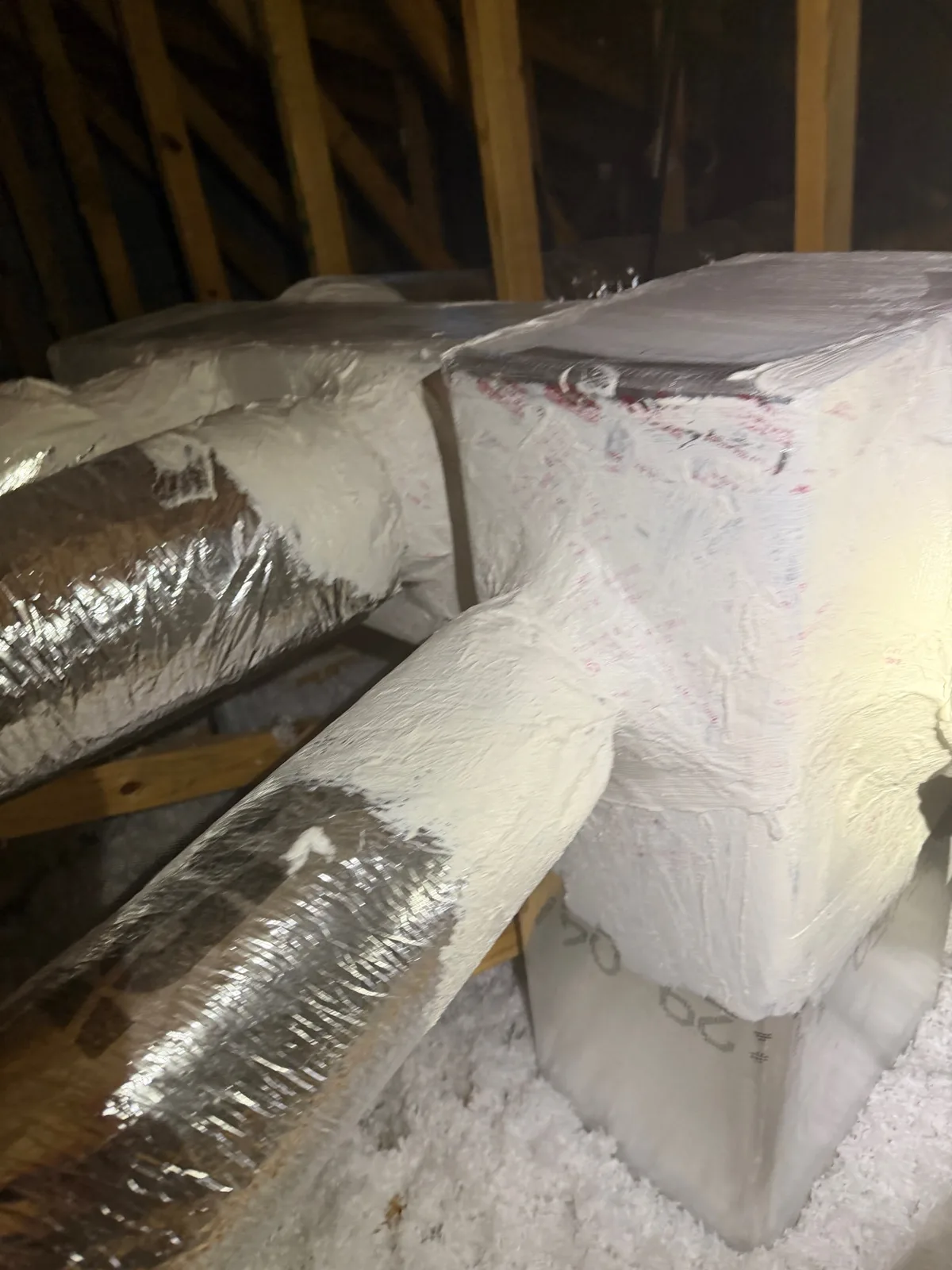
The repair that works is hand-applied UL 181M code-standards duct sealant, and it is worth understanding why the alternatives do not. Ordinary cloth duct tape fails on ducts — heat and pressure cycles loosen the adhesive until it peels off, often within a season. That is the tape you will find hanging in most leaking Weston attics. UL 181M code-standards duct sealant is different: a thick paste brushed over joints and seams that stays flexible as it cures, fills irregular gaps, and holds for years. Small gaps under a quarter inch take UL 181M code-standards duct sealant alone; larger gaps get fiberglass mesh pressed into the wet UL 181M code-standards duct sealant and covered with a second coat.
The work starts at the air handler and the plenum — where leaks are most common — and follows the system outward through every elbow, takeoff, and connection. Once the accessible joints are sealed, the ducts get re-insulated where the old insulation has failed, because sealing without insulation still leaves the ducts losing cooling to a hot attic. Leaks hidden inside walls are sealed with aerosol sealant blown through the pressurized system from the inside.
This is the service Albert describes as required when ducts are sweating, condensing, or carrying moisture — because a leaking joint is not just an efficiency problem. The cold air escaping from a supply leak chills the attic air around the duct, and the warm, humid attic air pulled in through a return leak feeds condensation on the coil and the ductwork.
And one more thing the estimate covers: while we are in the attic, we inspect the coil and the blower, because a system that has been running with leaky ducts has usually been pulling attic dust across its coil for years. Cleaning the coil and the ducts together is what makes the result last — the sealing stops the leak, and the cleaning removes what the leak dragged in.
Sealing accessible joints is one of the best-value repairs in the whole HVAC world: the materials are inexpensive, and the payback shows up in the very next electric bill. A full professional sealing job, including a leakage test before and after so you can see the number move, is priced on the size of the system and the access — a free on-site estimate gives you the exact figure.
Honesty matters here, too. Sealing fixes joints, seams, and connections. It does not fix ductwork that is torn, crushed, sagging, or so old its insulation has lost its value — and in a Weston home with original 1980s or 1990s flex duct, that is a real possibility. When the ducts themselves are done, the right answer is re-insulation or a full duct replacement, both priced on a free on-site estimate based on sizing, layout, and materials.
Air Duct Specialists LLC serves Weston and all of Broward County. Licensed CAC1825166. Fully insured. 350 five-star reviews. Same-day service, 7 days a week, 7am–11pm. Free estimates — what we quote is what you pay.
📞 (954) 302-1550 — BrowardHow much air do leaky ducts lose in a Weston home?
The U.S. Department of Energy estimates the typical home loses 20 to 30% of its conditioned air through duct leaks, gaps and deteriorated insulation — and in older attic systems the loss can reach 40%. That is air you already paid to cool, escaping into a 130- to 150-degree attic before it ever reaches a vent.
What are the signs my air ducts are leaking?
Uneven temperatures between rooms, weak airflow from some vents, energy bills that climb without a change in habits, excess dust around registers, whistling sounds near duct joints, and a system that runs longer than it used to. A leak tends to affect one branch consistently, in every season and at every thermostat setting.
How are duct leaks found?
Start with the accessible ductwork: run the system and feel along seams and joints for escaping air, hold a tissue strip or incense stick near joints, and look for dust streaks, peeling tape, and disconnected sections. For a precise number, a professional duct leakage (duct blaster) test pressurizes the system and measures the loss in CFM.
How are leaking air ducts sealed?
Reachable joints are sealed with UL 181M code-standards duct sealant — a brush-on sealant, reinforced with fiberglass mesh for larger gaps — and UL 181 foil tape on smooth metal seams. Ordinary cloth duct tape fails on ducts: heat and pressure cycles loosen the adhesive. Leaks hidden inside walls need aerosol sealant applied by a professional.
Do leaky ducts hurt indoor air quality?
Yes. A supply-side leak wastes cooled air; a return-side leak is worse for air quality, because it pulls hot, dusty attic air — insulation fibers, dust, and humidity — straight into the airstream and into your rooms. Sealing the returns is often the single biggest air quality improvement a duct system can get.
Are you licensed and insured?
Yes — Air Duct Specialists LLC is a licensed Florida air conditioning contractor, license CAC1825166, and fully insured. You or your property manager can verify the license through the Florida DBPR before any work begins.