★★★★★
350
☰
A ten-year-old Parkland home should not have worn-out ductwork — and usually it doesn't. It has ductwork that was installed too fast. Here are the builder-grade defects we find, and how repair brings them up to standard.
Parkland homeowners are often surprised to need duct work at all. The homes in Heron Bay, Parkland Golf & Country Club, MiraLago, and Watercrest are newer estates — many barely a decade old — and ductwork is supposed to last far longer than that. It does, when it is installed carefully. Air duct repair in Parkland, FL is usually not about age. It is about how the ductwork went in during construction: flex runs bent too sharply around trusses, collars fastened in a hurry, extra duct left sagging between supports. The house cools — just unevenly, noisily, and at higher cost than it should, from the day the builder handed over the keys.
The tell is a room that has never cooled like the others. Owners blame the thermostat zone, the sun exposure, the size of the equipment. Sometimes it is none of those. It is the branch run serving that room, pinched at a bend since the day it was hung. Repairing builder-grade defects means finding each one, fixing it to code standard instead of builder standard, and verifying airflow at the register afterward.
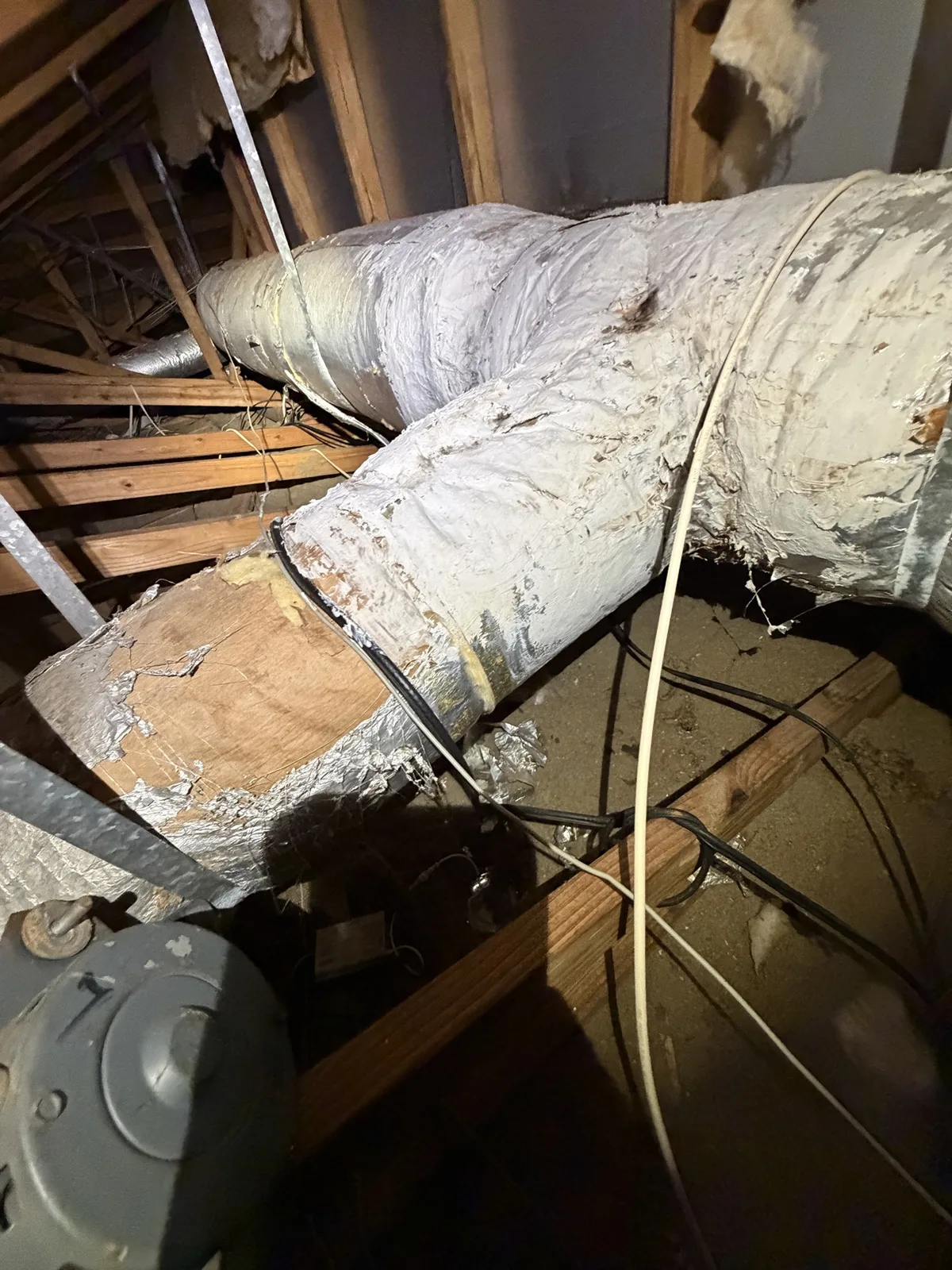
Kinked flex duct leads the list. Flex has to turn corners in an attic, but a bend pulled too tight collapses the inner core to a fraction of its diameter — the run might as well be half its size. Rooms at the end of a kinked run get a fraction of their designed airflow, permanently, until the bend is opened up. Loose collars come next: connections that were pushed onto a takeoff and taped, never properly secured, work themselves loose under vibration and attic heat, leaking cooled air and sometimes slipping off entirely.
Crushed runs happen where flex crosses a truss and gets compressed, or where a later trade — an electrician, a roofer, an alarm installer — steps on a run and leaves it flattened. And excess length is the quiet defect: flex left with slack coiled or bellied between hangers instead of pulled straight, so air fights friction and sag the whole way to the register. Big Parkland homes running two or three systems have dozens of runs; it only takes two or three bad ones to create the rooms everybody complains about.
The repair starts with airflow: we check delivery at the registers, note which rooms are starved, then trace those branch runs through the attic to the defect. Every find is photographed and shown to you before anything is quoted — in a newer home especially, you should see exactly what the builder left you. Kinked runs are re-routed with wide, gradual bends and hung with proper support so the core stays open. Crushed or torn lengths are cut out and replaced with new insulated sections, pulled straight and fully stretched. Loose collars are reseated, mechanically secured, and every connection we touch is sealed to UL 181M code standards.
Then we go back to the registers and measure again. The room that started the call should feel the difference the same day — that before-and-after verification, with photos, is how you know the repair delivered what the original installation should have. Most defect repairs are completed in a single visit, and we are in Parkland homes 7 days a week, 7am to 11pm.
This is where Parkland differs from older cities. The duct material in a ten- or fifteen-year-old home is typically sound — it is the routing, support, and connections that failed. Replacing a whole system to fix three bad runs makes no sense, and we will not sell it. Full replacement becomes the honest conversation only when the inspection shows a layout that was undersized or badly designed from the start, or damage spread across most runs. We will show you the photos and make the case either way. Done right the first time is the standard the repair is held to — the standard the original install should have met.
Every home is different — call for a free estimate and an exact price before any work starts. What we quote is what you pay. The cost of air duct repair in Parkland, FL depends on how many runs carry defects, where they sit in the attic and how accessible they are, how much material has to be replaced versus re-routed, re-supported, and resealed, and the number of systems in the home. A single kinked branch and a three-system estate with defects across several runs are different jobs, and the honest way to price either is to inspect it first — no hidden fees, and the same price for everyone.
Air Duct Specialists LLC serves Parkland and all of Broward County — 7 days a week, 7am–11pm, same-day service available. Licensed CAC1825166, fully insured, 350 five-star Google reviews. Our own certified technicians — never subcontractors.
📞 (954) 302-1550 — BrowardWhat duct defects do you find in newer Parkland homes?
Kinked flex runs bent too sharply at turns, collars that were never fully secured and have slipped, runs crushed where they cross trusses or were stepped on during later attic work, and excess flex left coiled or sagging instead of pulled straight. The houses are newer — the defects come from how fast the ductwork went in, not from age.
How do I know if a kinked duct is causing my warm room in Parkland?
The pattern is one or two rooms with weak airflow at the register while the rest of the house cools normally, in a home that is not old enough for the ductwork to have worn out. An attic inspection traces the branch serving that room — we photograph the kink, crush, or loose collar we find and show you.
Can a kinked or crushed flex duct be repaired?
Yes. A kinked run is re-routed with a wide, gradual bend and proper support, or the damaged length is cut out and replaced with a new insulated section pulled straight. Connections are mechanically secured and sealed to UL 181M code standards, and airflow is verified at the register before we leave.
Why does builder-standard ductwork underperform?
Production building rewards speed: flex duct gets stretched around obstacles, hung with too few supports, and connected quickly. It passes a rough inspection and cools the house — just unevenly and inefficiently. Repairing it to code standard means straight, supported runs, secured collars, and sealed joints, which is the performance the equipment was rated for.
How much does air duct repair cost in Parkland?
Every home is different, so there is no single number that fits. Cost depends on how many runs are affected, attic access, and how much material must be replaced versus re-routed and resealed. Call for a free estimate and an exact price before any work starts. What we quote is what you pay.
Are you licensed for duct repair in Parkland?
Yes — Air Duct Specialists LLC is a licensed Florida air conditioning contractor, license CAC1825166, and fully insured. Repairs are done by our own certified technicians — never subcontractors — and every connection we touch is sealed to UL 181M code standards.