★★★★★
300
☰
If your air vents sweat, drip water, or leave dark spotting on the ceiling of your Coral Gables home, the cause is almost always above your ceiling — aging duct insulation meeting 140-degree attic air under those barrel tile roofs. Here's why Coral Gables vents sweat, what we just found in a 33134 estate, and when condensation is telling you the ductwork is done.
Coral Gables is the City Beautiful — Spanish Revival homes from the 1920s, barrel tile roofs, coral rock walls, and estates that have stood through a century of South Florida summers. It's also one of the toughest environments in Miami-Dade for ductwork. Those gorgeous tile roofs turn attics into ovens from May through October, and many Gables homes — from 1920s landmarks to mid-century builds to renovated estates — still run on ductwork that was installed decades ago, long before modern insulation standards.
If you have condensation on air vents in Coral Gables — what most homeowners just call sweaty vents — here's the short version: water on your vents is not a roof leak and it's not your AC "working too hard." It's condensation — warm, humid air meeting a surface colder than the dew point. In almost every Gables home we see, that meeting point is in the attic, where cold air traveling through under-insulated or leaking ducts collides with hot, moisture-heavy attic air. The photos in this article are from an actual Coral Gables estate (33134) we inspected today. This guide walks through what condensation on vents is telling you, the specific causes we find in Coral Gables homes, what you can safely check yourself, and when the real fix is re-insulating or replacing the ductwork.
Condensation follows one rule: when warm, moisture-rich air touches a surface colder than the air's dew point, water forms on that surface. Your AC sends air through the ducts at roughly 55 degrees. Coral Gables attics in summer sit at 130 to 150 degrees with high humidity. If the ductwork between those two extremes isn't well insulated and sealed, the cold duct surface — and the metal vent boot behind your register — drops below the dew point, and the attic air's moisture condenses right onto it.
A little beading on the hottest afternoons of August can be normal in Florida. But if your vents sweat regularly, leave water stains or black spotting on the ceiling, or drip onto floors and furniture, that's not normal — it's a sign the insulation or sealing around your ducts has failed, or a connection has come loose, and moisture is doing damage out of sight.
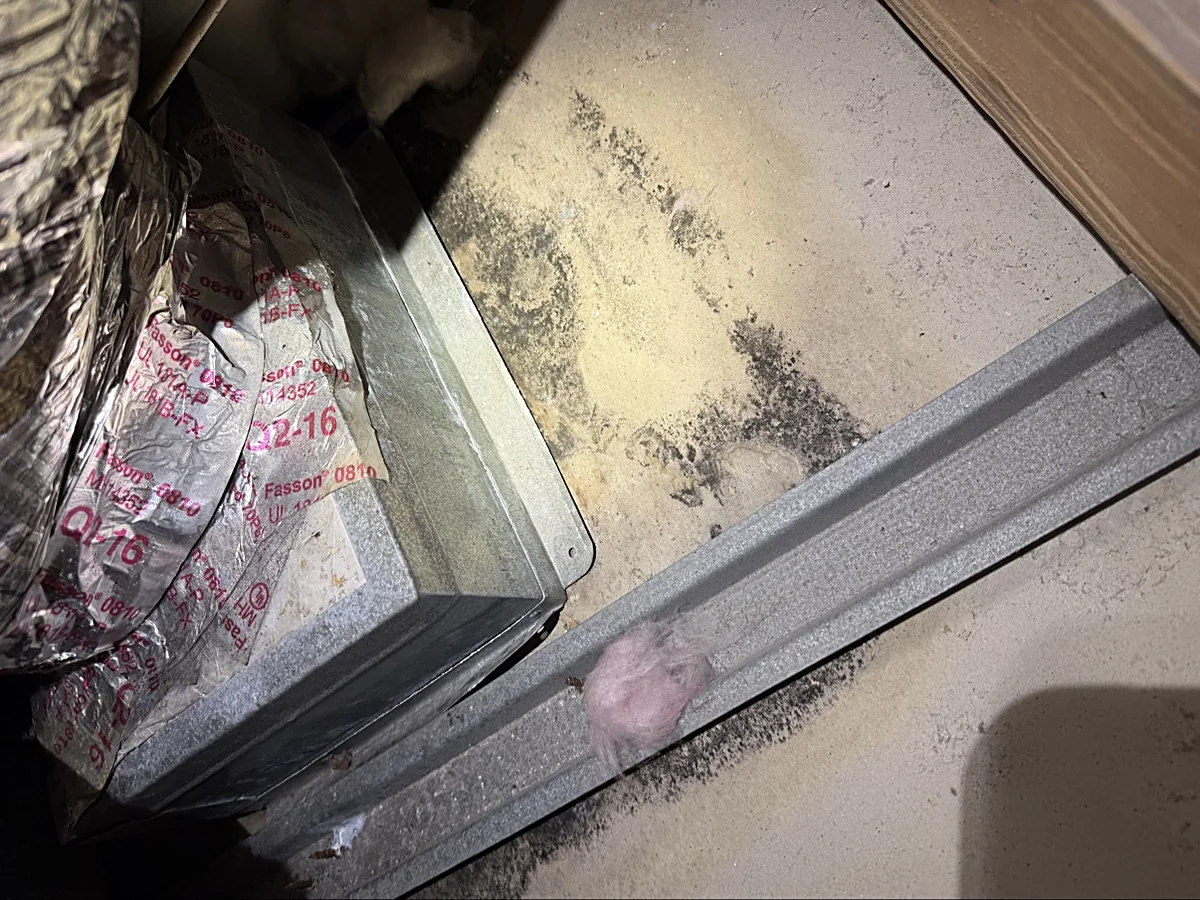
We inspected a Coral Gables estate in 33134 today, and it was a textbook case of condensation damage — the kind that starts in the attic and shows up on your ceiling. First: black spotting on the ceiling drywall around a duct boot. That's not dirt. That's moisture from condensation keeping the drywall damp long enough for microbial growth to take hold. The vent itself may have looked fine from the room, but the boot above it was sweating and the drywall was telling the story.
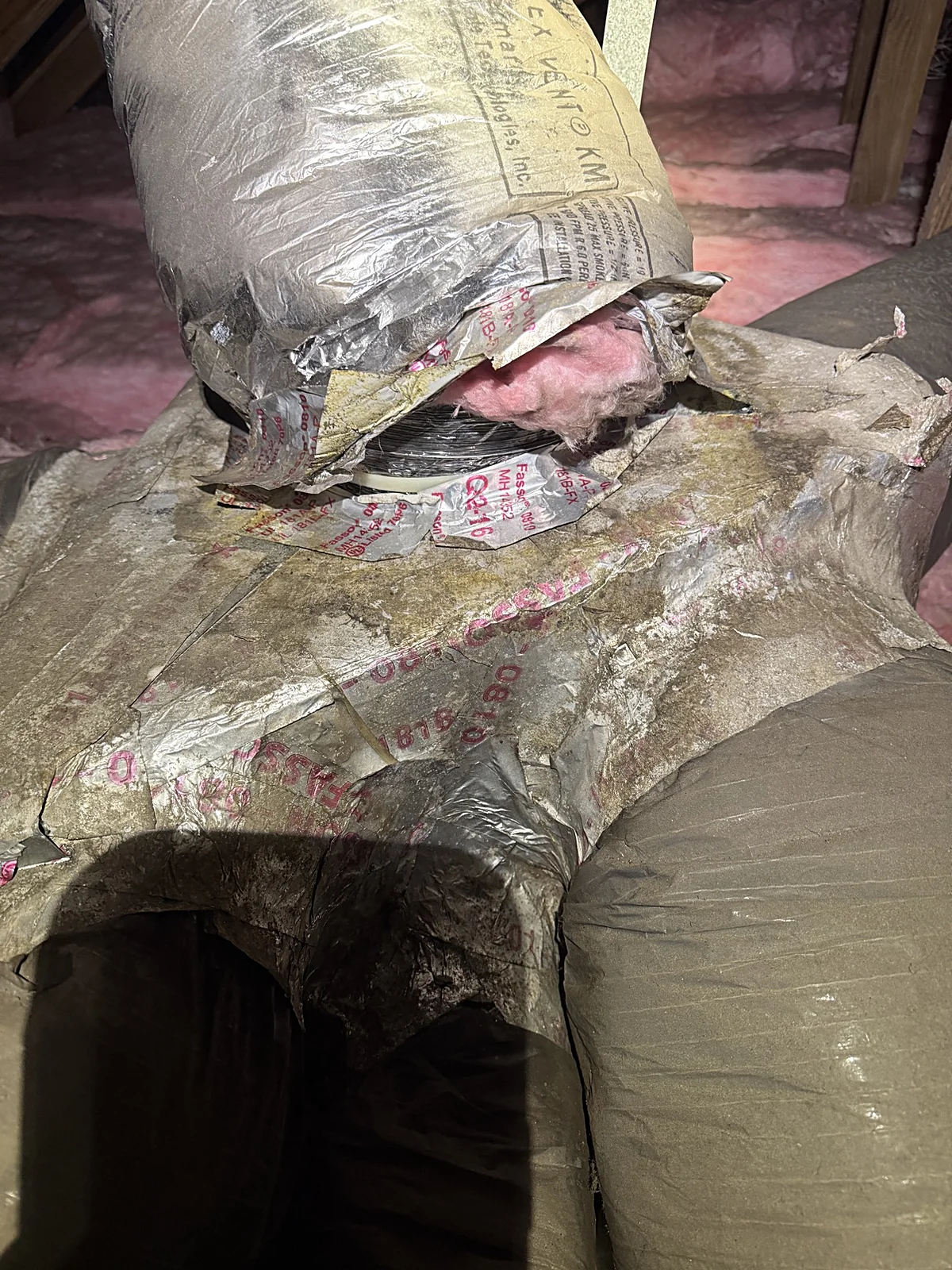
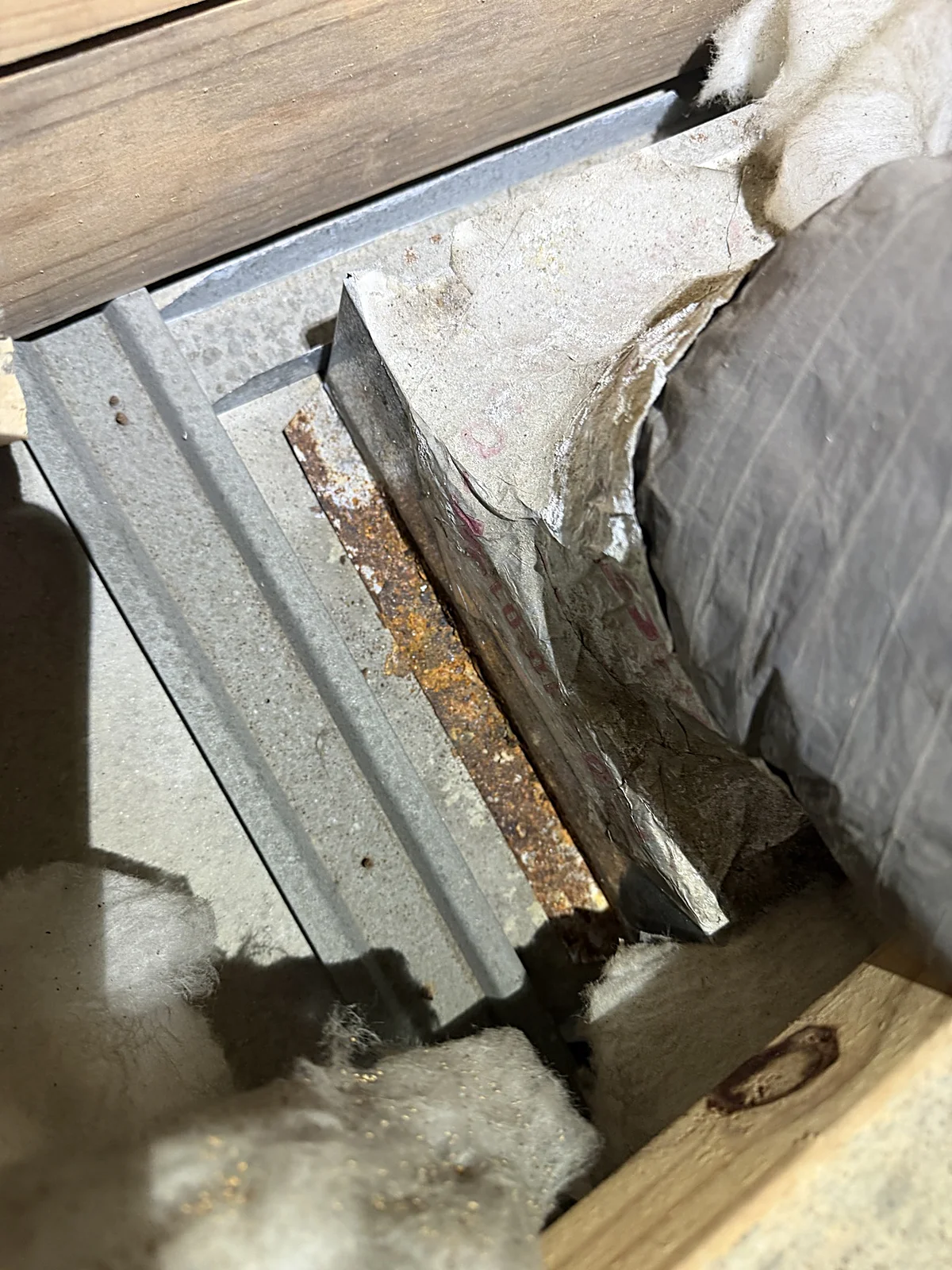
Second: a loose, improperly installed flex duct with torn insulation and exposed fiberglass — conditioned air escaping straight into the attic while hot, humid attic air reached the cold inner duct. Third: a duct boot that was visibly oxidized, with orange-brown rust on the metal. Metal doesn't rust from dry air. That oxidation is the signature of repeated, long-term condensation. Three different symptoms, one cause: the attic duct system had lost the insulation and sealing battle.
1. Aging, under-insulated ductwork. This is the number-one cause we see across Miami-Dade. Homes from the 1920s through the 1980s typically got R-4 or R-6 duct insulation — if the ducts were ever replaced at all. After decades in a 140-degree attic, that insulation compresses, separates at the seams, and its vapor barrier breaks down. Cold duct surface plus hot attic air equals condensation, every time.
2. Loose connections and torn insulation. Insulation and sealing are two different jobs. A duct can look insulated and still leak conditioned air at a loose joint or a torn outer jacket — exactly what we photographed in the 33134 estate today. Every opening lets cold air escape and humid attic air in, and condensation follows.
3. Oxidized, deteriorating vent boots. Metal boots corrode when they've been wet repeatedly. An oxidized boot means the sweating has been going on for a long time — and the corroded metal no longer seals properly, which makes the condensation worse. Rust on a boot is a timeline: this problem is not new.
4. Restricted airflow: dirty filters and coils. When airflow drops — a clogged filter, a dirty evaporator coil — less air moves across the coil, so the air that does move comes out colder. Colder vent surfaces sweat more easily. This is the simplest cause and the simplest fix.
5. An oversized AC that short-cycles. Many older Coral Gables homes got bigger-than-needed systems in past replacements. An oversized unit cools the house in minutes and shuts off before it has run long enough to pull humidity from the air. Cool but clammy rooms plus sweating vents is the classic signature.
6. Thermostat fan set to ON instead of AUTO. When the fan runs constantly, it keeps blowing room air over a cold, wet coil between cooling cycles — re-evaporating moisture the system just removed and raising indoor humidity. Switching the fan to AUTO is free and fixes a surprising number of mild cases.
Condensation that keeps coming back does real damage, quietly — and in a Coral Gables home, that damage hits finishes people paid a premium for. The water doesn't vanish: it soaks into ceiling drywall (the black spotting in our photo), bubbles paint, softens plaster, and feeds mold and mildew on duct surfaces, vent boots, and the surrounding structure. Once microbial growth starts in the system, spores travel through the whole house.
There's a money cost too. Wet, compressed insulation insulates worse, so the system runs longer to hold temperature. Condensation on your vents is often the first visible sign of ductwork that's costing you comfort and energy every single month — long before anything actually breaks.
Search "mold on air vents coral gables" and you'll find homeowners asking the same question in different words: is this just water, or is it mold? The honest answer is that persistent air vent condensation is how mold gets started. Mold needs three things — moisture, food, and time. A sweating vent supplies all three: constant dampness, a film of household dust as food, and weeks or months of undisturbed time inside a dark duct or behind a register.
Black spotting on the ceiling drywall around a vent — like the Coral Gables estate photo above — is the early warning. A musty smell when the AC kicks on is the next one. Visible growth on or around the register itself means it's been going on long enough that the whole run should be inspected, not just wiped down. Surface cleaning without fixing the moisture source is a loop you'll repeat every few months.
Before you call anyone, these checks take a few minutes and rule out the easy causes:
If the filter is clean, the fan is on AUTO, and you see spotting or rust anywhere near a vent, the problem is in the ductwork above the ceiling — and no thermostat setting will fix it. Leave attic inspections to a licensed contractor: old Coral Gables attics have fragile ceilings, limited decking, and no place for a misstep.
Here's the honest version, because this is where our reputation lives: sometimes sweating vents don't mean new ducts. A loose boot, a failed seal, or a single torn flex run can be repaired without touching the rest of the system. If that's what we find in your attic, that's what we'll tell you.
But when the sweating comes with the full picture — oxidized boots, torn and compressed insulation, loose connections across multiple runs, black spotting on the drywall — patching is throwing money at a system that's done. That's when the fix is one of two things:
Duct re-insulation — when the duct cores are still solid but the insulation around them has failed. We re-wrap the runs with modern, properly sealed insulation so the cold air inside never meets the hot attic air outside.
Full duct replacement — when the ducts themselves are deteriorated, kinked, undersized for the system, or contaminated. New R-8 ductwork, sealed to code, sized for your home and your AC. It's the permanent end of condensation, and it typically cuts the energy waste that was leaking through the old system too. (See what a full duct replacement involves.)
Straight numbers, no games. A minor repair — resealing a vent boot, fixing a loose connection — is the cheapest outcome and all many homes need. Duct re-insulation in a typical Coral Gables home runs roughly $1,000 to $2,700. Full duct replacement typically runs $1,500 to $7,000 depending on the size of the home and the system.
Every job starts with a free on-site estimate in your attic — we show you exactly what we see, in photos, and tell you whether it's a repair, a re-insulation, or a replacement. What we quote is what you pay: no hidden fees, no upselling, ever.
We work across the City Beautiful — from the waterfront estates of Gables Estates and Cocoplum to the historic streets of Andalusia and the Riviera section, from Gables by the Sea and the Old Cutler corridor to the University area, Almeria Avenue, and the Miracle Mile district. Whether your home is a 1920s Spanish Revival landmark or a modern new build, condensation follows the same physics — and the fix is the same honest attic inspection.
Our Coral Gables service area covers ZIP codes 33134, 33146, 33143, and 33158. We also coordinate with property managers and estate staff — discreet scheduling, protected finishes, and before-and-after photo documentation on every job.
Air Duct Specialists LLC serves Coral Gables and all of Miami-Dade County with free estimates, same-day service, and before-and-after photos on every job. Licensed CAC1825166. Fully insured. 300 five-star reviews.
📞 (305) 885-9911 — Miami-DadeWhy do my air vents sweat in my Coral Gables home?
Condensation forms when warm, humid air touches a surface colder than the dew point. In Coral Gables homes, cold AC air travels through ducts in 130 to 150-degree attics. If the ductwork is poorly insulated or leaking, cold duct surfaces and metal vent boots drop below the dew point and moisture condenses on them — showing up as water beading on vents, drips, or dark spotting on the surrounding ceiling drywall.
Is the black spotting on my ceiling from the air vent dangerous?
Black spotting around a vent is a sign that condensation has been keeping the drywall damp, which can lead to mold and mildew growth. It should be inspected promptly. The spotting itself is a symptom — the real problem is the moisture source, which is usually failing duct insulation, a loose connection, or a sweating vent boot above the ceiling.
Can a rusty or oxidized vent boot cause sweating?
The oxidation is a symptom, not the cause. Metal duct boots oxidize when they have been wet repeatedly — ongoing condensation corrodes the metal over time. A rusty boot tells you the sweating has been going on for a while and the connection it seals is likely compromised, letting humid attic air reach cold duct surfaces.
My Coral Gables home was built in the 1960s. Are my ducts too old?
Many Coral Gables homes — from 1920s Spanish Revival estates to 1960s and 70s builds — still run on original or decades-old ductwork with older R-4 or R-6 insulation. After 30 or more years in a 140-degree attic, that insulation compresses, separates at the seams, and loses its vapor barrier, which is exactly when condensation problems appear. An attic inspection shows whether yours are still doing their job.
Will a dehumidifier stop condensation on my air vents?
A whole-home dehumidifier can reduce indoor humidity and help with mild sweating, but it does not fix the root cause when the ducts themselves are poorly insulated or leaking in a hot attic. If condensation comes from hot attic air hitting cold, under-insulated ducts, the attic side of the problem remains no matter how dry the rooms are. Insulation and sealing are the permanent fix.
What does it cost to fix condensation on vents in Coral Gables?
It depends on the cause. A simple repair like resealing a vent boot or fixing a loose duct connection is the least expensive outcome. Duct re-insulation typically runs roughly $1,000 to $2,700, and full duct replacement typically runs $1,500 to $7,000 depending on home size and system. Air Duct Specialists provides free on-site estimates — what we quote is what you pay.
Why do my air vents sweat only in summer in Coral Gables?
Summer delivers both ingredients condensation needs at once: your AC runs longer, so ducts and vent surfaces get colder, while Coral Gables attics reach 130 to 150 degrees with peak humidity. Cold metal meeting hot, moist attic air is exactly when droplets form. If the sweating disappears in cooler months, aging duct insulation is the most likely cause.
Water is dripping from my air vent — what should I do?
Water dripping from air vents is never normal — it means condensation has been building long enough to overwhelm the register. First, protect the area below — put a towel down and check the ceiling for spotting, staining, or softness. Switch your thermostat fan to AUTO and replace the filter, since restricted airflow makes sweating worse. Then get the ductwork inspected: active dripping means sustained condensation, and the longer moisture sits on drywall and duct surfaces, the more damage it does. Don't just wipe the vent — find the source above the ceiling.
What's the difference between duct re-insulation and duct replacement?
Re-insulation keeps your existing duct cores and re-wraps them with modern, properly sealed insulation — the right fix when the ducts are solid but their insulation has failed. Replacement removes the old system entirely and installs new, correctly sized ductwork sealed to code — the right fix when ducts are deteriorated, kinked, undersized, or contaminated. A free on-site attic inspection determines which one your home actually needs.
Is Air Duct Specialists licensed and insured?
Yes — Air Duct Specialists LLC is a licensed Florida air conditioning contractor, license CAC1825166, and fully insured. Homeowners can verify the license through the Florida DBPR before any work begins.