★★★★★
300
☰
If your vents bead with water or drip in your Weston home, the cause is almost always above your ceiling — aging duct insulation or poor duct design meeting 140-degree attic air. Here's what it means and when it's telling you the ductwork is done.
In Weston, sweaty air vents are common. Most homes — Weston Hills to the Isles to Savanna — were built between the mid-1980s and the early 2000s, with attics hitting 130 to 150 degrees all summer. Many still run on original R-4 or R-6 ductwork that's spent 25-plus years baking up there.
Water on your vents is condensation: it forms when a cold surface meets air too warm and damp for it. In almost every Weston home, that meeting point is in the attic — cold air in under-insulated ducts colliding with hot, humid attic air. The vent is just where the symptom shows up. Here's what sweating vents are telling you, the causes we find in Weston attics, and when the real fix is re-insulation or replacement.
1. Aging, under-insulated ductwork. The number-one cause in Weston. Homes from the 80s and 90s got R-4 or R-6 duct insulation, which compresses and separates at the seams after two decades in a 140-degree attic. The Department of Energy lists condensation prevention as a primary reason ducts must be insulated and sealed.
2. Air leaks at connections and vent boots. Insulation and sealing are different jobs. A duct can be insulated yet still leak cold air at loose joints or where it meets the vent boot — letting humid attic air in.
3. Restricted airflow: dirty filters and coils. A clogged filter or dirty evaporator coil drops airflow, so the air that moves comes out colder. Colder vent surfaces sweat more easily. Simplest cause, simplest fix.
4. An oversized AC that short-cycles. An oversized unit cools the house in minutes and shuts off before pulling humidity from the air — cool but clammy rooms plus sweating vents.
5. Bath fans and dryer vents dumping into the attic. Some older Weston builds terminate these in the attic instead of outside. Every shower pumps moisture into the space your ducts live in, raising the attic's dew point.
6. Thermostat fan set to ON instead of AUTO. A fan left on ON re-evaporates moisture the system just removed. Switching to AUTO is free and fixes many mild cases.
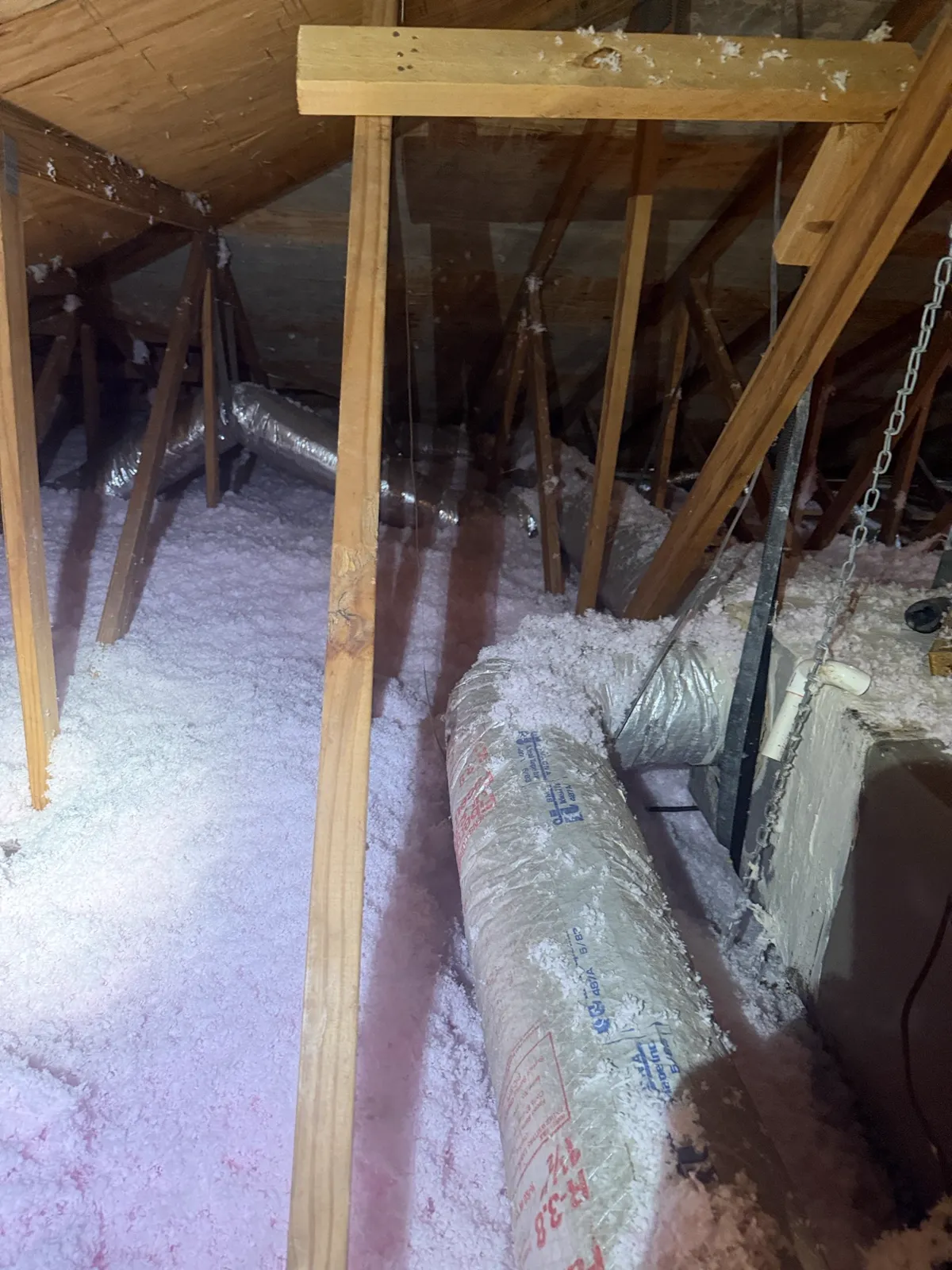
7. Improper duct design: sharp bends and up-and-down routing. A duct should run straight and well-supported. In many Weston attics we find the opposite: flex duct routed straight up, over a truss or obstruction, and back down again with a sharp slope — like the photo above. Every hard bend and uphill run adds static pressure and robs the rooms of airflow. The AC then runs longer and colder to keep up, keeping vent surfaces below the dew point longer — and sweating follows.
Recurring condensation does real damage quietly. Dripping water soaks the drywall — stains, bubbling paint, soft spots — and persistent moisture on duct surfaces and vent boots is where mold and mildew take hold. It also costs you monthly: wet, compressed insulation insulates worse, so the system runs longer.
Before you call anyone, these checks take a few minutes and rule out the easy causes:
Filter clean, fan on AUTO, vents still sweating — especially if attic insulation looks worn? The problem is in the ductwork, and no thermostat setting will fix it.
The honest version: sometimes sweating vents don't mean new ducts — a disconnected vent boot, a failed seal, or one crushed run can be repaired. But when original R-4/R-6 ducts are compressed, sagging, and sweating across multiple rooms, patching is throwing money at a system that's done. Then the fix is one of two things:
Two real fixes exist: re-insulation — when duct cores are solid but their insulation failed — and full replacement — when ducts are deteriorated, kinked, undersized, contaminated, or the layout itself is bad. Sharp bends, up-and-down routing, and crushed runs can't be insulated into working; they have to be re-routed. New code-sealed, properly routed ductwork ends sweating vents permanently and cuts the energy waste too.
Straight numbers. A minor repair — resealing a vent boot or a disconnected run — is the cheapest outcome, and all many homes need. Re-insulation in a typical Weston home runs $1,000 to $2,700. Full duct replacement runs $1,500 to $7,000 depending on home and system size.
Every job starts with a free on-site estimate — we show you what we see in photos and tell you if it's a repair, re-insulation, or replacement. What we quote is what you pay: no hidden fees, no upselling, ever.
Air Duct Specialists LLC serves Weston and all of Broward County with free estimates and same-day service. Licensed CAC1825166. Fully insured. 300 five-star reviews.
📞 (954) 302-1550 — BrowardWhy do my air vents sweat only in summer in Weston?
Summer delivers both condensation ingredients at once: the AC runs longer, so ducts and vents get colder, while Weston attics hit 130 to 150 degrees with high humidity. Cold metal meets hot, moist air — droplets form. If sweating vanishes in cooler months, aging insulation is the likely cause.
Can sweaty air vents cause mold in my home?
Yes. Persistent condensation keeps duct surfaces, vent boots, and nearby drywall damp — and moisture plus duct dust creates conditions where mold and mildew can grow. Dark discoloration around a vent or a musty smell when the AC kicks on means get it inspected before it spreads.
My Weston home was built in the 1990s. Are my ducts too old?
Likely. Many Weston homes from the 80s through the early 2000s still run original R-4 or R-6 ducts. After 20-plus years in a 140-degree attic, that insulation compresses and separates at the seams — exactly the age range where we find sweating ducts most.
What does it cost to fix sweating vents in Broward County?
Depends on the cause. A simple repair like resealing a vent boot is minor. Re-insulation typically runs $1,000 to $2,700; full replacement $1,500 to $7,000 depending on home and system size. Free on-site estimates — what we quote is what you pay.
Can poor duct design make my air vents sweat?
Yes. Flex duct with sharp bends, or running straight up and back down with a steep slope, adds static pressure and loses airflow to the rooms. The AC runs longer and colder to keep up, keeping vent surfaces below the dew point longer — and sweating follows. Bad routing has to be fixed with re-routed ductwork, not just more insulation.
Is Air Duct Specialists licensed and insured?
Yes — Air Duct Specialists LLC is a licensed Florida air conditioning contractor (CAC1825166) and fully insured. Homeowners can verify the license through the Florida DBPR.