★★★★★
350
☰
Ask what size AC you need in Boca Raton and you will get a chart. Charts are a start, not an answer. Here is how to walk through your own home — square footage first, then ceilings, sun exposure, and insulation — and why the final answer still needs a load calculation.
What size AC do I need in Boca Raton, FL? It is the first question almost every homeowner asks when a system dies or a replacement quote lands, and it is the question most often answered badly. The bad answer is a chart and nothing else: find your square footage, read across, buy that tonnage. The chart is not wrong — it is incomplete. A Boca home is not a square footage number. It is a volume of air, a set of windows facing a particular sun, a roof and attic of a particular age, and a duct system of a particular condition. Walk through all four with us, and you will understand your sizing answer instead of just receiving it.
Start with the vocabulary. Air conditioner capacity is measured in tons, and one ton equals 12,000 BTU per hour — the heat the system can remove in an hour. In Florida's climate zone, the familiar rule of thumb is roughly one ton per 500–600 square feet of living space. A 1,500 sq ft home starts around 2.5 to 3 tons; a 2,000 sq ft home around 3.5 to 4 tons; a 2,500 sq ft home around 4 to 5 tons, often split across two systems. That is the neighborhood. Now here is what moves you within it — or out of it entirely.
Measure the living space the system actually cools, not the number on the property appraiser's site. Garages do not count, and neither do unconditioned Florida rooms never tied into the duct system. A 2,400 sq ft listing with a 400 sq ft garage is a 2,000 sq ft cooling load — and the wrong square footage in is the most common sizing error in a phone quote. If your home has two systems, size each zone separately.
Square footage is an area; your air conditioner cools a volume. A Boca home with 8-foot ceilings and a Boca home with 12-foot vaulted ceilings can share a floor plan and need different tonnage, because the vaulted home holds far more air — and far more heat rising into that tall space. Open-plan living areas, two-story entries, and loft spaces all add volume the chart never sees. When a contractor never asks about your ceilings, they are not sizing your home; they are sizing a spreadsheet.
This is where two identical Boca homes diverge. A west-facing wall of glass takes the full Florida afternoon sun and turns a room into a heat collector; shaded, low-e, or impact glass on the same wall changes the load dramatically. A 1978 Boca home with original insulation and single-pane windows carries a heavier load per square foot than a 2018 home built tight with modern insulation — which is why older homes often need more tonnage per square foot, and newer ones less. Attic insulation matters twice over: thin attic insulation lets 130–150°F attic heat press down on the living space, and ductwork running through that attic loses cooled air before it ever reaches a room.
Additions change the answer too. The Florida room enclosed in 2009, the bedroom added over the garage, the kitchen opened into the living space — none were in the original calculation. This is why copying the old unit's tonnage is a gamble: the house it was sized for may not be the house standing there today.
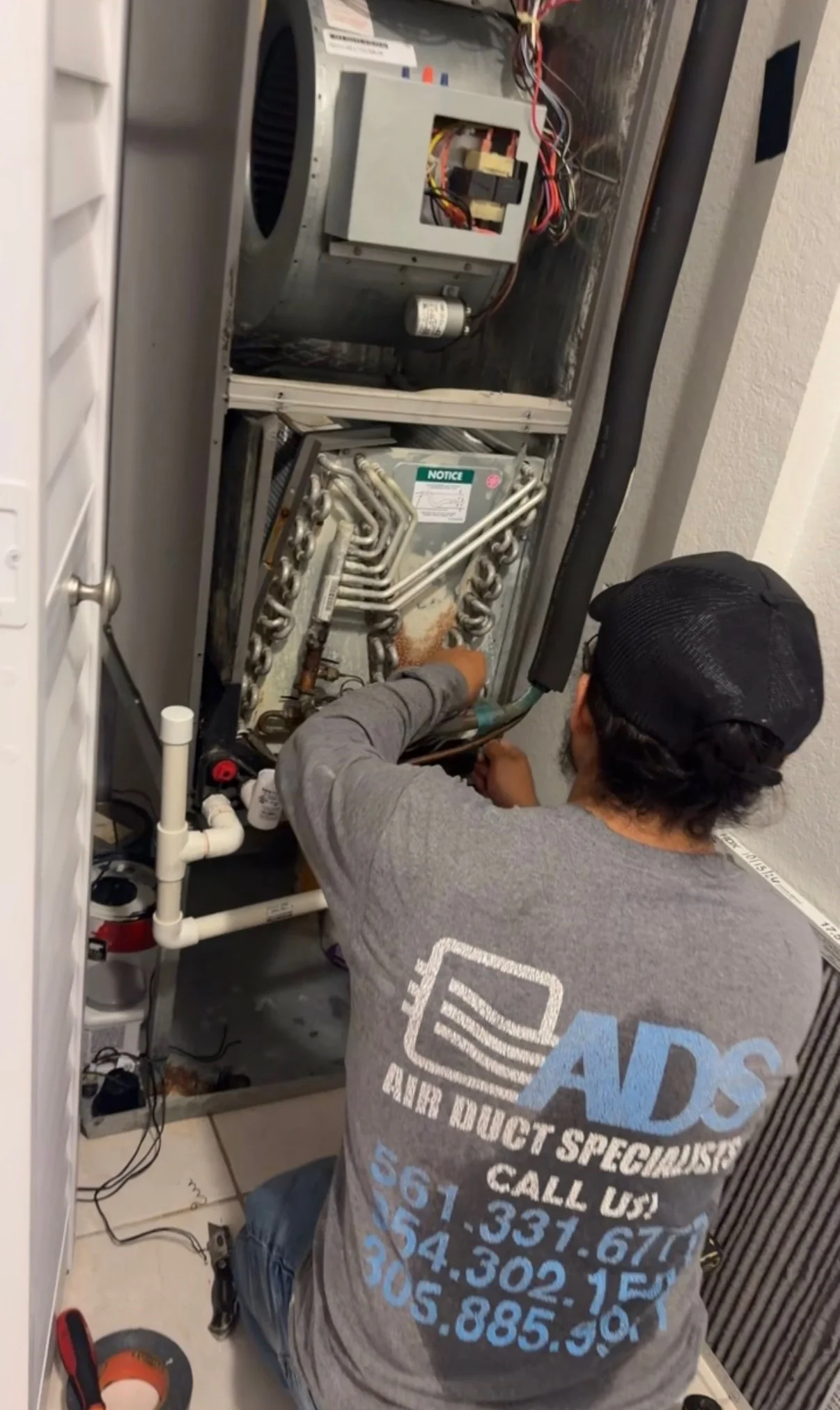
Here is the step most sizing conversations skip, and the one closest to our work. Ducts are sized for the airflow a unit delivers. Put a larger unit on ductwork built for a smaller one and you get noise, pressure problems, and rooms that still do not cool evenly — the tonnage on the label never becomes comfort in the rooms. Put the right unit on leaking, crushed, or under-insulated attic ducts and a share of that cooling bleeds into a 140-degree attic before it reaches a vent. Any honest sizing conversation includes the ducts: their size, their condition, and their insulation. When we assess a replacement, we look at the duct system with the same care as the equipment, because the two are one system.
The walk-through above gets you to an educated range. The final answer comes from a Manual J load calculation — the industry-standard assessment that weighs square footage, volume, windows, orientation, insulation, air leakage, and duct condition together and produces a tonnage for your specific home. It is the difference between a guess that happens to be close and a number you can defend. It also protects you in both directions: against the oversized unit that short cycles, leaves the house clammy at 72°, and wears its compressor out on constant starts; and against the undersized unit that runs all afternoon and never catches up. In Boca Raton, where the air conditioner is also the dehumidifier, getting this right is not a comfort luxury — it is humidity control, mold prevention, and equipment life, all in one decision.
If your current system short cycles, runs nonstop, or leaves some rooms clammy and others warm, do not start by shopping tonnage. Start with a free on-site assessment. Sometimes the answer is a different size; sometimes it is a repair — a dirty coil, low refrigerant, or leaky attic ducts — that makes the existing size right again.
Air Duct Specialists LLC serves Boca Raton and all of Palm Beach County. Licensed CAC1825166. Fully insured. 350 five-star reviews. Same-day service, 7 days a week, 7am–11pm. Free estimates — what we quote is what you pay.
📞 (561) 331-6777 — Palm BeachWhat size AC do I need for a 2,000 sq ft home in Boca Raton?
As a rough starting point, Florida homes often land around one ton per 500–600 square feet, so a 2,000 sq ft Boca home typically starts in the 3.5 to 4 ton range. Ceiling height, sun exposure, windows, insulation, and the home's age all move that answer — which is why it is a starting point, not a purchase order.
How do I find the tonnage of my current AC?
Check the outdoor unit's model number, not the serial number. Look for a two-digit code — 24, 36, 48 — and divide by 12. A 36 in the model number means a 3-ton unit. That tells you what you have, not whether it was ever the right size.
Should I just buy the same size AC I already have?
Not automatically. The old unit may have been sized wrong on day one, and the house has changed since — additions, new windows, better or worse insulation. Copying the old tonnage copies the old mistake. A load calculation checks the house as it is today.
What happens if my AC is too big for my Boca home?
It short cycles: cools the air fast, shuts off before removing humidity, and starts again minutes later. The house feels clammy at 72°, the compressor takes far more hard starts, and humidity stays high enough for mold to thrive. In Boca, oversized is the most common sizing mistake.
What happens if my AC is too small?
It runs nearly nonstop on hot afternoons and still loses ground, with afternoon temperature creep in the sunniest rooms. But the same symptom can come from a dirty coil, low refrigerant, or leaky ducts — so a diagnosis comes before a bigger unit.
Do you offer free sizing estimates in Boca Raton?
Yes. Air Duct Specialists LLC offers free on-site estimates across Boca Raton and Palm Beach County, including a look at the ductwork the new unit will feed. Licensed CAC1825166, fully insured, 350 five-star reviews.