★★★★★
350
☰
Some duct systems are past repairing. When runs are torn, collapsed, undersized, or leaking in too many places to chase one by one, replacement is the honest answer — and it is a job where doing it right the first time matters more than doing it fast. Here's when replacement beats repair, what a code-compliant replacement actually includes, and what it costs.
Every duct system has a lifespan, and in South Florida that lifespan is shorter than in milder climates. Ducts live in hot, humid attics, run nearly year-round, and sit in conditions that degrade insulation, dry out flexible duct jackets, and invite moisture into every joint that was not sealed properly in the first place. At some point the system stops being a set of fixable problems and becomes a system that needs to be replaced — and recognizing that point honestly is worth more than any single repair.
This page covers that decision: when replacement beats repair, what a code-compliant replacement includes, what it costs, how long it takes, and how to tell a contractor who will do it right from one who will cut corners you cannot see from below the ceiling.
A single damaged run is a repair. A system failing in several places at once is a replacement. The situations where we recommend replacement:
Replacement is not always the answer, and we will say so when it is not. If the system is fundamentally sound and the problem is one or two runs, a repair is the honest recommendation — and it costs far less. The estimate tells you which one your system actually needs, and why.
A duct replacement done to code is not just new material hung in the attic. It is a sequence, and skipping steps in that sequence is how systems end up leaking, sweating, and underperforming within a year. Our process:
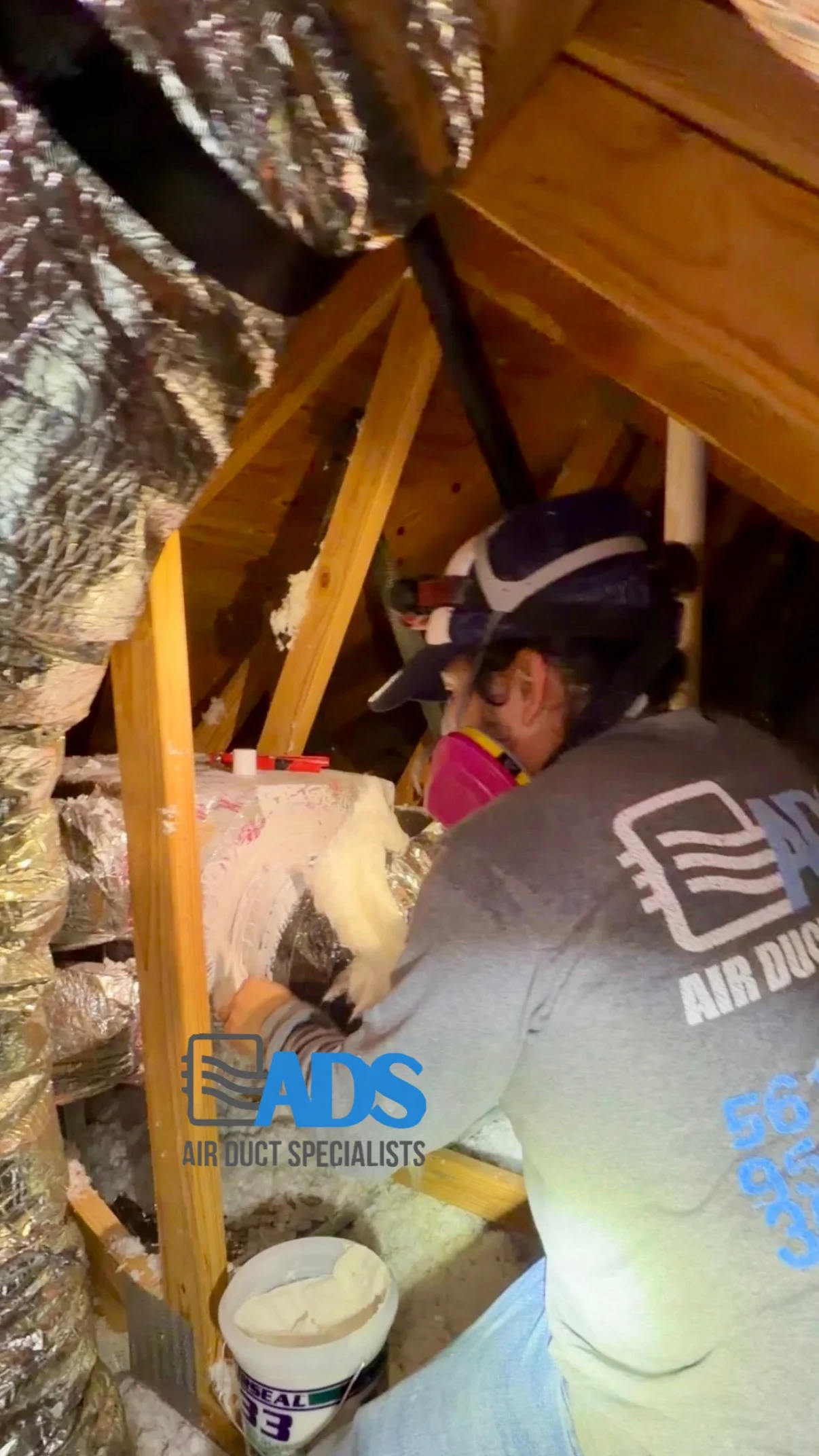
Removal of the old system. The existing ductwork, boots, and registers come out first — including the material inside the ceiling cavities that a shortcut crew would leave behind. Removal matters because old, damaged material left in place hides leaks, holds moisture, and makes it impossible to verify the new work.
Proper sizing. Every run is sized for the room it serves — its size, its sun exposure, its airflow requirement — not copied from whatever was there before. Copying the old sizes preserves the old system's mistakes, including the undersizing that made rooms uncomfortable in the first place.
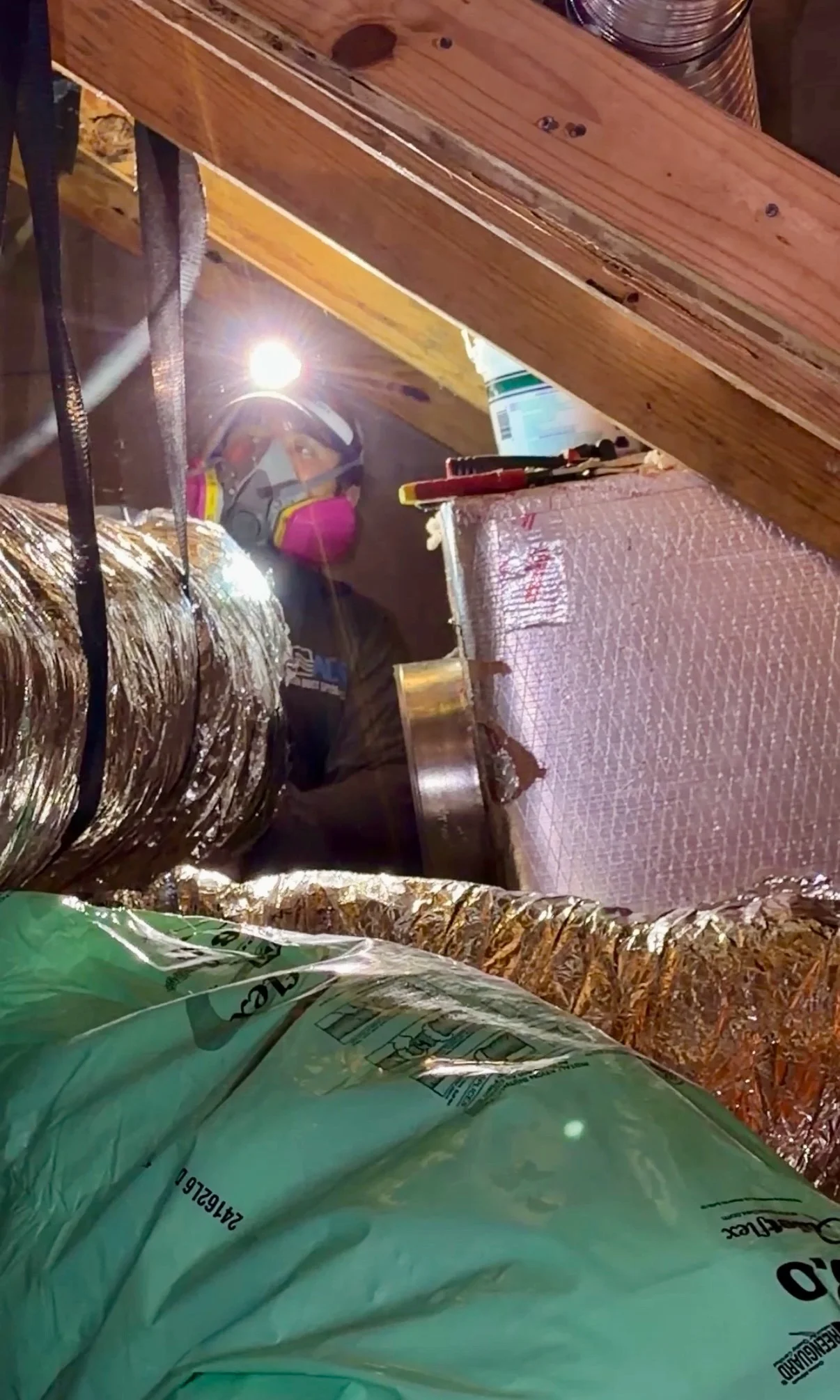
Routing without kinks or crushing. Runs are routed with gentle bends and proper clearance, never pinched around framing, never crushed under stored items, never left sagging between supports. A kinked run delivers a fraction of its designed airflow, and no amount of equipment can compensate for it.
Mastic sealing at every joint. Every connection — duct to duct, duct to boot, boot to register — is sealed with mastic and sealed on completion. Tape alone is not a seal, and unsealed joints are the single most common source of lost cooled air and humid attic air leaking in. This is the step shortcut crews skip most, because it is invisible from below the ceiling and time-consuming to do right.
Strapping and support. New runs are hung and strapped at proper intervals so they hold their shape, keep their insulation intact, and do not sag into low spots where moisture collects. Strapping that compresses the insulation defeats the insulation, so supports are placed to hold the run without crushing it.
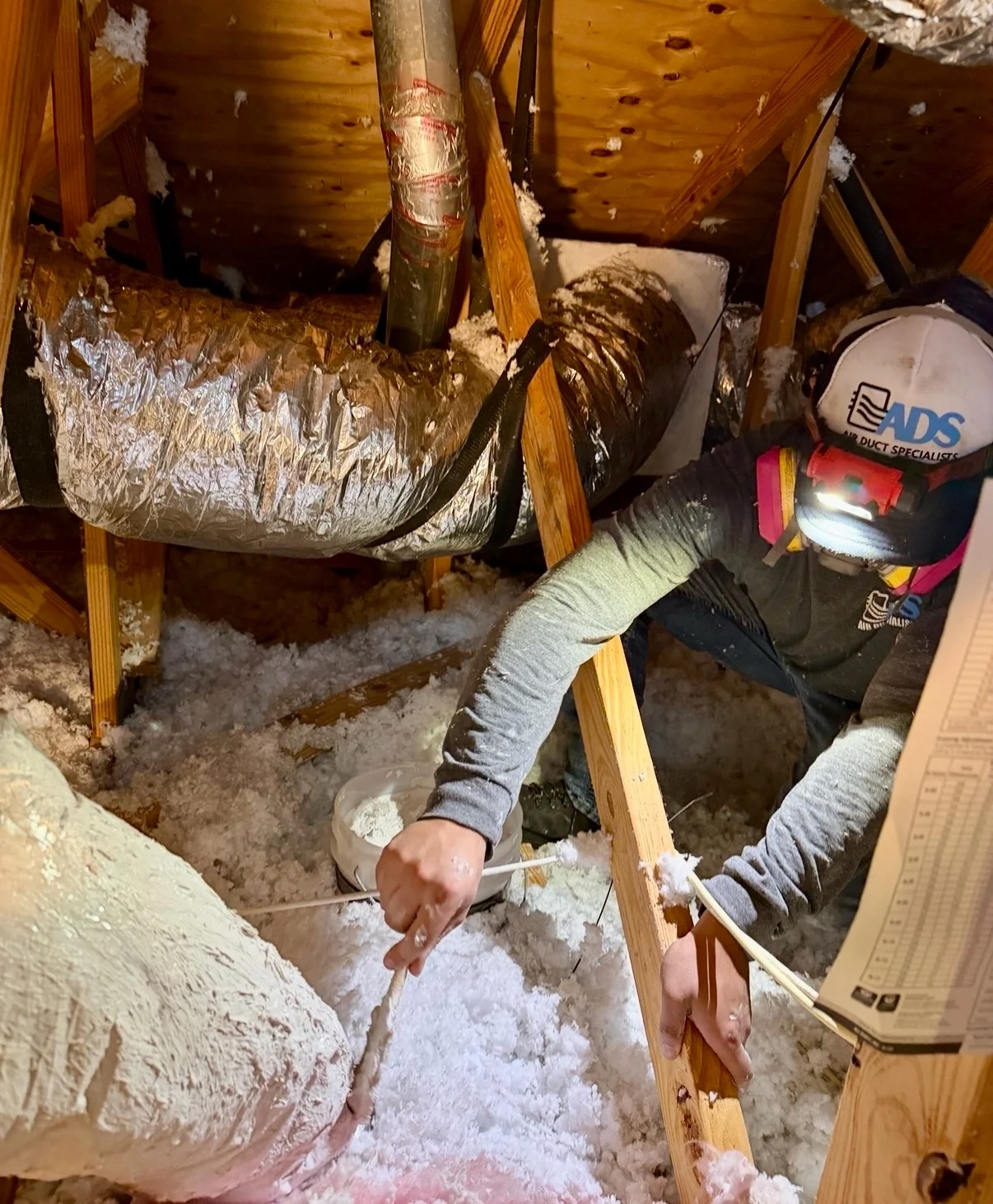
Insulation to code standard. New ductwork is insulated to the standard the code requires for attic installations in this climate, so cooled air stays cool inside the duct and the outside of the duct stays warm enough that humid attic air does not condense on it.
Room-by-room airflow checks. When the work is done, airflow is checked at every register against what each room needs. A replacement that is not verified room by room is a replacement that might have repeated the old system's sizing mistakes under new material. Done right the first time means verified, not assumed.
Most homeowners judge a duct system by what they can see from inside the house: the registers, the airflow at each vent, the temperature in each room. The problems that decide whether a system needs replacing are almost all above the ceiling, and they are the kind of thing that looks fine in a quick glance:
An estimate from us includes that attic-level inspection, because a replacement quote written from the living room is a guess, not a price.
New duct work and full duct replacement runs $3,500 to $9,500 for an average smaller residential home, varying on home sizing, layout, and materials required. What moves a job within — or beyond — that range:
What we quote is what you pay. The estimate is firm for the scope described in it, and if inspection finds something that changes the scope, you hear about it before the work changes — not after.
At most, installs take 1-2 days for most average homes, depending on the size of the home, the number of runs, and how accessible the attic or crawl space is. Larger homes and high-rise units with restricted access can take longer. Your estimate will include a realistic timeline for your specific job — and a crew that promises a full-system replacement in a few hours is a crew planning to skip the sealing, the strapping, or the verification.
These are different things, and the distinction matters. A free on-site estimate is what you get when you are considering a replacement: we inspect the existing system, measure the home and the runs, and give you a firm price for the full job before any work begins. A paid service-call inspection is a diagnostic visit for a specific problem — a drip, a dead zone, a noise — priced separately, where the deliverable is a diagnosis and a repair price rather than a replacement quote. We will always tell you which one you are getting before we come out, so there is no surprise on either side.
Condos and high-rises add logistics that single-family jobs do not have: elevator reservations, loading-dock access, building rules about work hours and materials, and ceiling spaces shared with neighbors. We coordinate with building management on scheduling and access, protect common areas and finishes while we work, and keep the job inside the approved scope — the same discipline that applies to any multi-unit building.
Big homes are a different job from an average house: multiple air handlers and zoned systems, hundreds of feet of supply and return ductwork, and runs that serve rooms with very different sun exposure and airflow needs. Sizing room by room matters more, not less, at that scale — and verification at every register is what keeps a large system from cooling unevenly.
Coastal homes face salt air, which corrodes metal components faster and punishes any joint that was not properly sealed. In coastal installations, sealing quality and material choice matter even more than inland, because the environment attacks the weak points first.
Our on-site estimates for duct replacement are free. We inspect the existing system in the attic, measure the home and the runs, and give you a firm price for the full replacement before any work begins. If you'd like, we can also check the rest of the system while we are up there — insulation condition, coil condition, and airflow — so you hear about a second problem from us now rather than discovering it yourself later. There is no obligation, and what we quote is what you pay.
Air Duct Specialists LLC replaces ductwork across Miami-Dade, Broward, and Palm Beach counties — including Miami, Coral Gables, Pinecrest, Fort Lauderdale, Davie, Weston, Boca Raton, Delray Beach, and Palm Beach. Same-day service is available, and we are open 7am–11pm, 7 days.
If you'd like, we will come out, inspect your existing ductwork, and give you a firm price for replacement — no charge for the estimate, no obligation. Licensed CAC1825166. Fully insured. 350 five-star reviews. Open 7am–11pm, 7 days.
📞 (561) 331-6777 — Palm Beach 📞 (954) 302-1550 — Broward 📞 (305) 885-9911 — Miami-DadeWhen should air ducts be replaced instead of repaired?
Replacement makes sense when the system is aged and failing in several places at once — torn, collapsed, or undersized runs, repeated leaks that keep coming back, insulation that has failed across the system, or a major renovation that changes the home's layout and airflow needs. A single damaged run is usually a repair; a system failing everywhere is a replacement.
How much does air duct replacement cost in South Florida?
New duct work and full duct replacement runs $3,500 to $9,500 for an average smaller residential home, varying on home sizing, layout, and materials required. Larger homes, high-rise units with restricted access, and systems with many runs cost more. A free on-site estimate gives you a firm price for your specific home before any work begins.
How long does an air duct replacement take?
At most, installs take 1-2 days for most average homes, depending on the size of the home, the number of runs, and how accessible the attic or crawl space is. Larger homes and high-rise units with restricted access can take longer. Your estimate will include a realistic timeline for your specific job.
What does a code-compliant duct replacement include?
Proper sizing for each room's airflow needs, routing that avoids kinks and crushing, mastic sealing at every joint and boot connection, strapping and support that holds runs without sagging or compressing the insulation, insulation restored to code standard, and a room-by-room airflow check when the work is done. Every connection is sealed on completion — no shortcuts.
Do you offer free estimates or paid inspections for replacement?
We offer free on-site estimates for duct replacement: we inspect the existing system, measure the home and the runs, and give you a firm price for the full replacement before any work begins. A paid service-call inspection is a different thing — a diagnostic visit for a specific problem, priced separately — and we will always tell you which one you are getting before we come out.
Are you licensed and insured?
Yes — Air Duct Specialists LLC is a licensed Florida air conditioning contractor, license CAC1825166, and fully insured. You can verify the license through the Florida DBPR before any work begins.
Air Duct Installation
New duct systems, sized and sealed to code
Duct Sealing & Repair
When the system is sound and only runs need fixing
Attic Insulation
Insulation that keeps new ductwork performing
HVAC Coil Cleaning
A clean coil protects a new duct system
Air Duct Replacement in Pinecrest
Replacement signs, process, and cost in depth
Air Duct Installation in Davie
New ducts for big homes, done to code