★★★★★
350
☰
Damp patches, staining, or dripping on a ceiling that has no roof leak above it? In a South Florida home, that is often condensation — humid attic air meeting a ceiling your air conditioner has cooled from below. Here's why it happens here, how it differs from a roof leak, and how it gets fixed.
Most of what you will read online about ceiling condensation was written for cold climates — for winter, when warm indoor air rises into a freezing attic and condenses on the underside of a roof deck. That is a real problem, but it is not the South Florida problem, and following northern advice for a Florida home will send you looking in the wrong place. Here the physics run in reverse: the attic is the hot, humid side, and the living space below is the cold side, because the air conditioner runs most of the year. Condensation forms when that humid attic air reaches a ceiling surface cooled below the dew point by the conditioned room beneath it.
The result looks like a leak. Damp patches on the ceiling, staining around light fixtures, paint bubbling or peeling, and in heavier cases actual dripping. Homeowners understandably call a roofer first. But when the roof is sound and the attic shows no wet path from above, the moisture is coming from the air itself — and the fix is in the ceiling assembly, the insulation, and the ductwork, not on the roof.
Condensation needs two things: humid air, and a surface cold enough to cool that air below its dew point, the temperature at which water vapor turns back into liquid. A South Florida attic supplies the first in abundance. Attics here run hot and saturated for most of the year, and the air in them carries far more moisture than indoor air. The air conditioner supplies the second: it holds the living space — and therefore the ceiling drywall — cool, often much cooler than the attic air above it.
In a well-built ceiling, those two air masses never meet. Insulation slows heat transfer, and an air barrier keeps attic air out of the ceiling cavity. Ceiling condensation appears when that separation breaks down, and the breakdowns we find most often are:
The pattern of the moisture tells a trained inspector a great deal about which of these is at work: staining around fixtures points to penetrations, a patch above a hatch points to insulation, and widespread dampness with high energy bills points toward duct leakage. That is why diagnosis starts in the attic, looking at the ceiling from above.
Three different problems can all put water on or near a ceiling, and each has a different fix. Getting the diagnosis right first saves the cost of fixing the wrong one:
Ceiling condensation appears when the AC is running in humid weather, often across a broad area or around fixtures and penetrations, and it comes and goes with humidity and system runtime rather than with rain. The attic above shows no wet path from the roof deck, and the moisture is on the ceiling surface or in the cavity just above it.
A roof leak follows storms. It usually stains one spot, the stain often grows after heavy rain and dries out between storms, and an attic inspection shows a wet trail running down from the roof deck, a flashing, or a vent pipe boot on the roof. If the timing tracks the weather, the roof is the first place to look.
Sweating vents are a related but separate problem: moisture forming on the vent register itself, where cold air passes through a fitting exposed to humid air. Sweating vents are localized to the register and the ceiling immediately around it, while ceiling condensation can appear across open ceiling areas far from any vent. The two can occur together — an unsealed vent boot can cause both — but they are diagnosed and described separately, and a page on one should not be confused with the other.
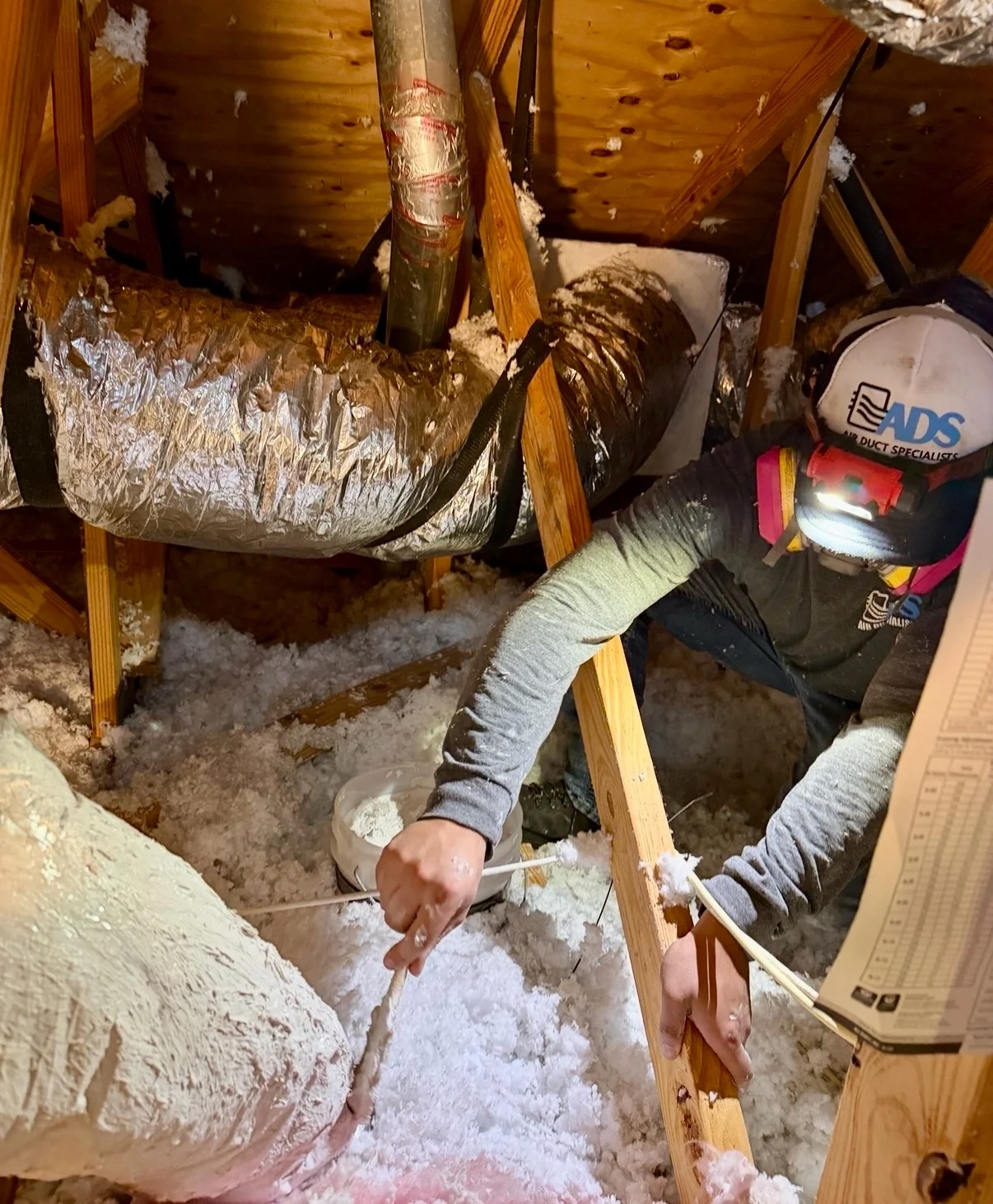
A ceiling condensation inspection is an attic inspection first and a ceiling inspection second. From above, we check:
You get the findings in plain language and a firm price for the fix. If the problem turns out to be a roof issue rather than a condensation issue, we will say so — fixing the wrong thing helps no one, and a roofer is the right call for a roof.
The fix follows the cause, and it is usually a combination of sealing, insulation, and ductwork — not a coat of paint. Repainting a stain without fixing the moisture source just hides the problem until the stain returns, often worse.
Air sealing the ceiling plane. Gaps at recessed lights, hatches, boots, and wiring and plumbing penetrations are sealed so humid attic air can no longer reach the ceiling cavity. This is the single highest-impact step in most ceiling condensation jobs, because it removes the moisture supply itself.
Restoring insulation. Areas where insulation is missing, compressed, or water-damaged are brought back to continuous coverage, so the drywall stays closer to room temperature and condensation has no cold surface to form on.
Sealing leaking ductwork. Joints and boots that are dumping cold air into the attic are sealed with mastic, which stops the ceiling from being chilled from above and stops the energy waste at the same time. Where duct sections are damaged beyond sealing, repair or replacement of those sections is part of the scope.
Ceiling condensation is not an emergency in the burst-pipe sense, but certain signs mean it should be diagnosed promptly rather than watched:
In any of those cases, the realistic next step is an inspection, not a repaint. The inspection identifies the cause, and the fix addresses it — so the ceiling can be repaired once, properly, instead of repainted repeatedly.
Our on-site estimates for ceiling condensation are free. We inspect the ceiling and the attic above it, identify the cause, and give you a firm price for the fix before any work begins. If you'd like, we can also check the ductwork and insulation across the rest of the attic while we are up there, so a second problem gets found now rather than later. There is no obligation, and what we quote is what you pay.
Air Duct Specialists LLC diagnoses and repairs ceiling condensation across Miami-Dade, Broward, and Palm Beach counties — including Miami, Coral Gables, Pinecrest, Fort Lauderdale, Davie, Weston, Boca Raton, Delray Beach, and Palm Beach. Same-day service is available, and we are open 7am–11pm, 7 days.
If you'd like, we will come out, find out why your ceiling is condensing, and give you a firm price for the fix — no charge for the estimate, no obligation. Licensed CAC1825166. Fully insured. 350 five-star reviews. Open 7am–11pm, 7 days.
📞 (561) 331-6777 — Palm Beach 📞 (954) 302-1550 — Broward 📞 (305) 885-9911 — Miami-DadeWhat causes ceiling condensation in a Florida home?
In South Florida, ceiling condensation happens when warm, humid attic air reaches a ceiling surface that the air conditioning has cooled below the dew point. The usual paths are unsealed penetrations — recessed lights, attic hatches, vent boots, wiring and plumbing gaps — missing or thin insulation above the ceiling, and duct leakage that dumps cold air into the attic and chills the ceiling from above.
How do I know if it is condensation and not a roof leak?
Condensation appears when the AC is running in humid weather, often across a broad area or around fixtures and penetrations, and it comes and goes with humidity rather than rain. A roof leak follows storms, usually stains one spot, and leaves a wet path from the roof deck in the attic. An attic inspection above the affected ceiling settles the question.
Is ceiling condensation dangerous?
It is not an emergency the way a burst pipe is, but it should not be ignored. Ongoing moisture can stain and soften drywall, create conditions for mold growth in the ceiling cavity, and damage paint and finishes. Active dripping, spreading stains, or sagging drywall mean the problem should be diagnosed promptly before the damage grows.
How is ceiling condensation fixed?
The fix targets the cause found on inspection: sealing air leaks at ceiling penetrations, restoring insulation above the ceiling, and sealing ductwork that is leaking cold air into the attic. Fixing the moisture source matters more than repainting the stain, because paint over an active condensation problem just hides it until the stain returns.
Do you offer free estimates for ceiling condensation?
Yes. Air Duct Specialists LLC offers free on-site estimates across Miami-Dade, Broward, and Palm Beach counties. We inspect the ceiling and the attic above it, identify the cause, and give you a firm price for the fix before any work begins.
Are you licensed and insured?
Yes — Air Duct Specialists LLC is a licensed Florida air conditioning contractor, license CAC1825166, and fully insured. You can verify the license through the Florida DBPR before any work begins.
Attic Insulation
Restoring insulation that keeps ceilings from going cold
Duct Sealing & Repair
Sealing ductwork that leaks cold air into the attic
Air Duct Cleaning
Cleaning where moisture has already left growth behind
HVAC Coil Cleaning
Airflow and humidity problems start at a dirty coil
Why Are My Air Vents Sweating in Boca Raton?
The related problem at the vent register itself
Coral Gables Service Area
Ceiling and duct service across Coral Gables