★★★★★
350
☰
On an acre-plus lot, your home is spread wide — and so is your ductwork. Long flex runs cross a huge, hot attic to reach the far bedrooms, the guest house, and the workshop, and every extra joint along the way is a place cooled air can slip out. When a Loxahatchee home will not cool evenly, the duct system is usually the first place to look.
Air duct leaks in Loxahatchee, FL hit harder than they do in a compact subdivision home, for a simple reason: distance. The U.S. Department of Energy puts typical duct losses at 20 to 30% of conditioned air, and a system that has to push cooled air sixty or eighty feet through a 130- to 150-degree attic gives that air far more chances to escape. Air Duct Specialists is now serving Loxahatchee, and leaks are the problem we expect to find most often out here — not broken equipment, but good equipment feeding a duct system full of small exits.
Think about what cooling a sprawling single-story home actually means. One air handler, often at one end of the house, feeds runs that cross the entire footprint. Every foot of that run sits in attic heat, losing cooling through its walls even when it is sealed — and when it is not sealed, it loses the air itself.
A tract home might have a dozen duct connections. A custom home on a Loxahatchee acre can have two or three times that: long trunk lines, branches to rooms spread across a big footprint, separate runs to a guest house or in-law suite, and ductwork added later for a workshop or a barn converted into living or office space. Each addition was tied into the system with its own elbows, takeoffs, and collars — and each one is a joint that can loosen, a seam that can open, a collar that can pull away.
Then there is the country factor subdivision attics rarely deal with: wildlife. Raccoons and rodents get into rural attics, chew through flex duct, crush runs by nesting on top of them, and shred the insulation jacket. A chewed run on the far side of a big attic can leak for a whole season before anyone climbs up and sees it.
Age and heat finish the job. Tape used on older joints dries out and peels in attic temperatures. Flex duct sags between its hangers over the years, stressing every connection. And the longer the run, the more the pressure drops along it — so a leak near the far end starves the room it was supposed to feed almost completely, while rooms near the handler stay cold.
The pattern is consistent, even if the house is not. Watch for:
One test separates a leak from a hot room: consistency. Sun exposure warms a room in the afternoon and lets it recover at night. A leaking branch underperforms at every hour, at every thermostat setting. If the same space is always the warm one, follow its duct run.
Start early in the morning, before the attic becomes an oven. Set the fan to "on," bring a strong light, and walk every run you can reach — on a Loxahatchee home that walk is longer than you expect, so be systematic. Feel along each joint and collar: escaping air on your hand is a supply leak, suction is a return leak. A tissue strip held near a joint will flutter where air is moving. Look for the country-specific evidence too — droppings, nesting material, and chew marks along the flex.
For an exact figure, a professional duct leakage test seals the registers and returns, pressurizes the system with a calibrated fan, and reports the loss in CFM. On a multi-building property it also answers the question that matters most: which building's runs are doing the leaking, so you fix the right system first.
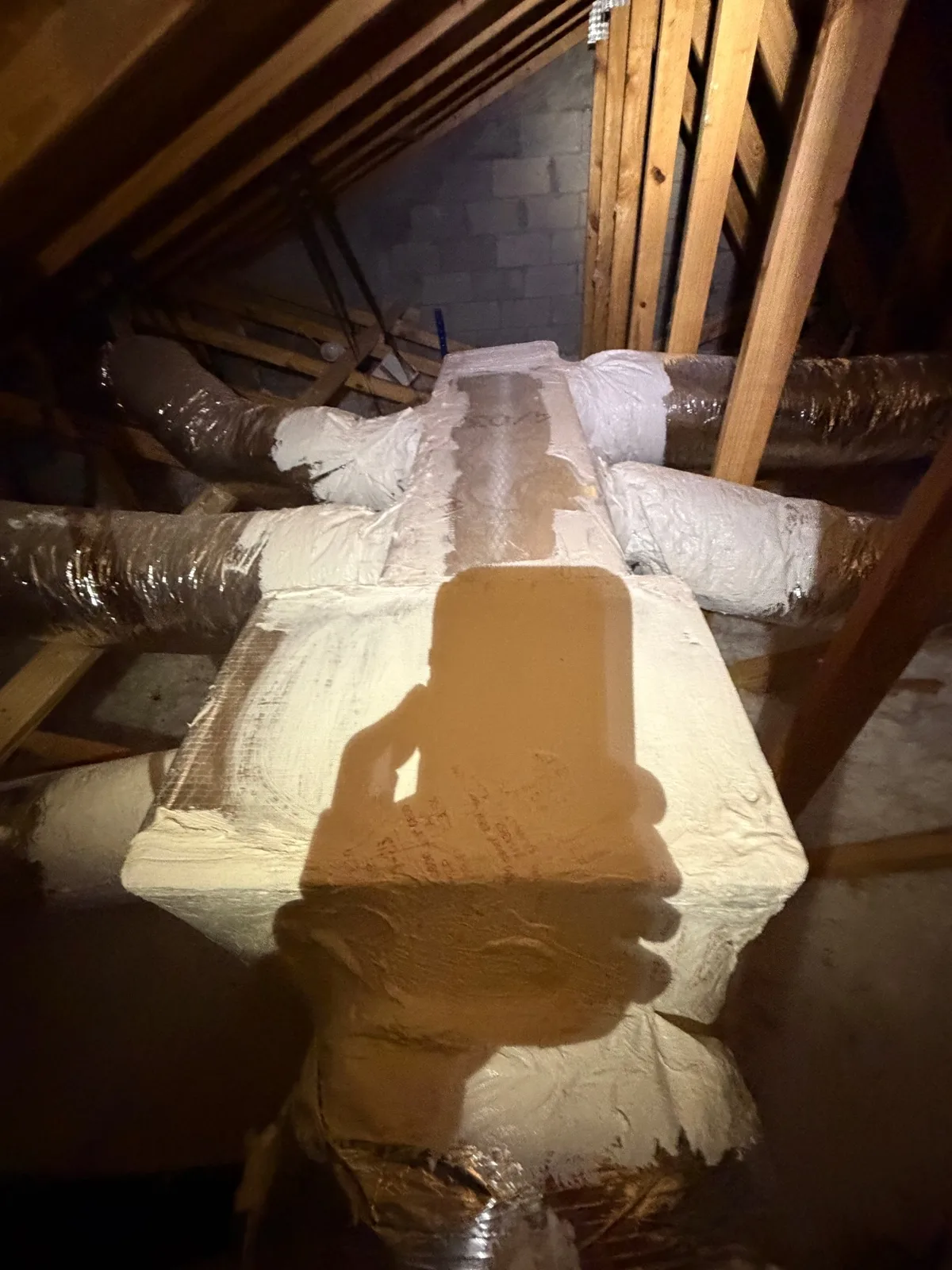
The repair is UL 181M code-standards duct sealant, brushed over every accessible joint, seam, and connection, starting at the air handler and plenum — the highest-pressure, leakiest point in the system — and working outward along each run. Gaps wider than a quarter inch get fiberglass mesh set into the wet UL 181M code-standards duct sealant and a second coat over the top. On smooth metal seams, UL 181 foil tape does the job. What never goes on is ordinary cloth duct tape: attic heat destroys its adhesive, and most of the peeling tape we pull off old joints is exactly that.
Pest damage gets an honest split. A run that is chewed, crushed, or torn is replaced, not patched — UL 181M code-standards duct sealant cannot rebuild a duct. Intact runs with leaking joints are sealed and kept. Once the system is tight, we renew insulation where the old wrap has failed, because a sealed duct in a bare jacket still bleeds cooling into the attic on those long runs. And while we are up there, we check the coil and blower: a system that has pulled attic air through return leaks has usually been coating its coil with dust for years.
For air duct leaks in Loxahatchee, FL, sealing is priced by the size of the system and how far the runs reach — a free on-site estimate gives you the exact number before any work starts, and what we quote is what you pay. It is one of the better-payback repairs in HVAC: the next electric bill is usually where you see it.
When the duct material itself has failed — insulation gone, flex torn or crushed across whole sections — sealing joints will not save it. Duct re-insulation and a full duct replacement are both quoted on a free on-site estimate; replacement for an average smaller residential home varies on home sizing, layout, and materials required, and estate-sized systems with outbuildings are priced by that same free estimate, because no two properties out here are laid out the same. If your ducts only need sealing, that is what we will tell you — no upselling, ever.
Air Duct Specialists LLC is now serving Loxahatchee and Palm Beach County. Licensed CAC1825166. Fully insured. 350 five-star reviews. Same-day service, 7 days a week, 7am–11pm. Free estimates — what we quote is what you pay.
📞 (561) 331-6777 — Palm BeachDo you now serve Loxahatchee?
Yes. Air Duct Specialists is now serving Loxahatchee and Palm Beach County, including acreage homes, guest houses, and converted outbuildings in the 33470 area. Estimates are free, and same-day service is available 7 days a week, 7am–11pm.
Why do Loxahatchee homes have more duct leak points?
Loxahatchee homes sit on 1.25-acre-plus lots with wide, sprawling footprints, so duct runs are longer and pass through more elbows, takeoffs, and connections than a subdivision home. Guest houses, workshops, and barn conversions add still more joints. Every connection is a place air can escape, so a typical estate system simply has more chances to leak.
Can wildlife damage ducts in a Loxahatchee attic?
Yes. In country attics, raccoons and rodents chew through flex duct, crush runs by nesting on them, and tear the outer jacket and insulation. The damage often sits far down a long run where nobody looks, leaking cooled air for months. Any duct inspection out here should include a check for pest damage along the full length of every run.
What are the signs my air ducts are leaking?
Rooms at the far end of the house that never cool down, weak airflow from distant vents, a guest house or workshop that stays warm no matter the setting, electric bills climbing without a change in habits, dust streaks around registers, and a system that runs far longer than it used to. A leak hits the same branch every time, in every season.
How are leaking air ducts sealed?
Accessible joints are sealed with UL 181M code-standards duct sealant, a brush-on sealant reinforced with fiberglass mesh over larger gaps, working outward from the air handler and plenum through every elbow and takeoff. Torn or crushed sections of flex are replaced, not patched, and failed insulation is renewed once the sealing is done. Ordinary cloth duct tape is not used — attic heat breaks its adhesive down.
How much does it cost to fix air duct leaks in Loxahatchee, FL?
Sealing accessible joints is priced by system size and attic access after a free on-site estimate. Where insulation has failed, duct re-insulation is quoted exactly on a free on-site estimate. Full duct replacement is quoted exactly on a free on-site estimate for an average smaller residential home; larger estate-sized systems are priced by the free on-site estimate. What we quote is what you pay.
Are you licensed and insured?
Yes — Air Duct Specialists LLC is a licensed Florida air conditioning contractor, license CAC1825166, and fully insured. The license can be verified through the Florida DBPR before any work begins. We carry 350 five-star Google reviews, and our own certified techs do the work — never subcontractors.