★★★★★
350
☰
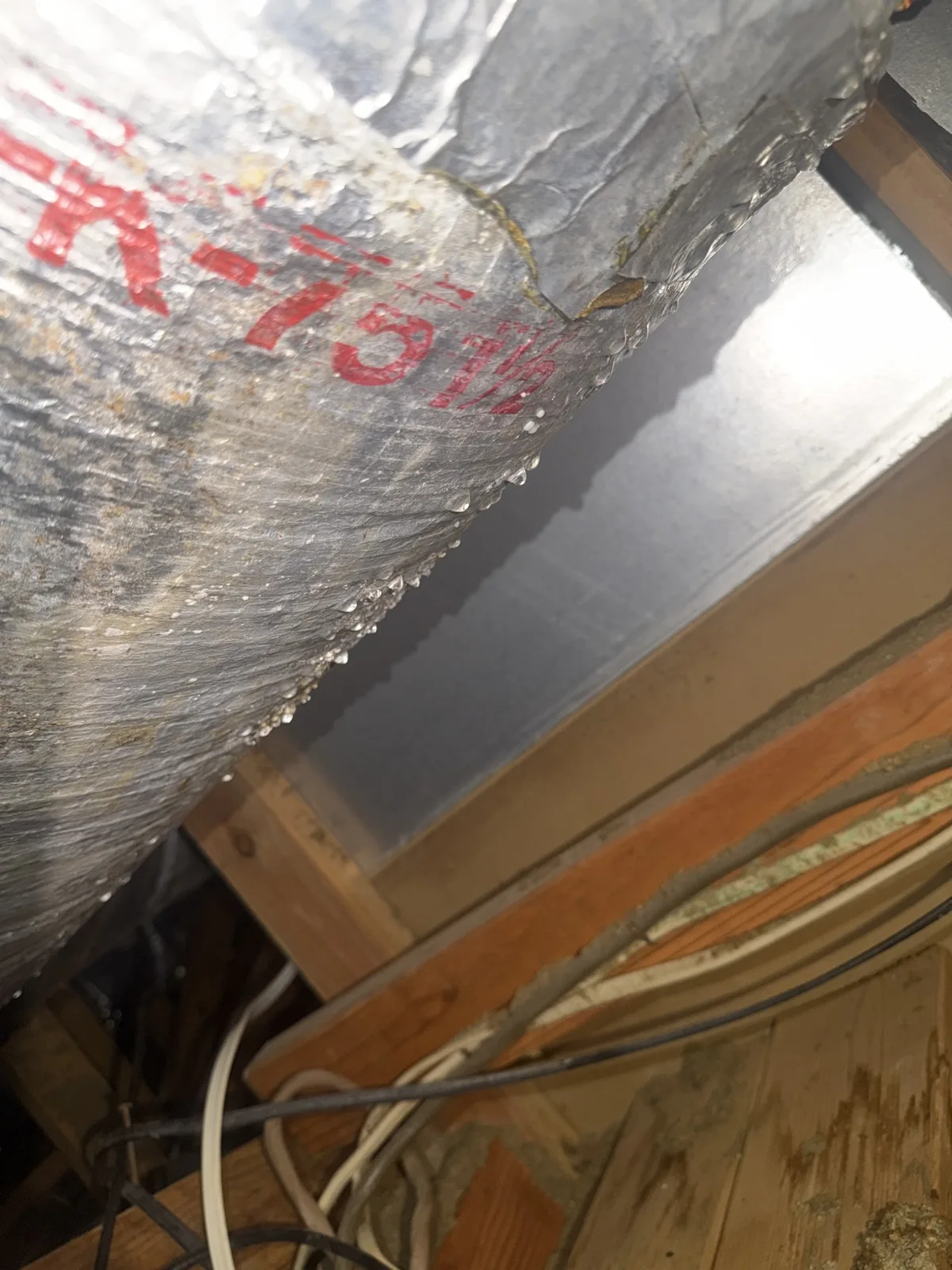
Most homeowners notice the symptom at the vent — a sweating register, a drip on the ceiling. But climb into a West Boca attic in July and you will find the real story: the ductwork itself is beaded with water, sweating like a glass of iced tea, because the insulation that was supposed to protect it has failed. The vents were never the problem. The ducts were.
Sweaty ductwork in your attic in Boca Raton, FL is a physics problem with a South Florida twist. Your air conditioner pushes supply air through the ducts at around 50 to 55 degrees. Those ducts run through an attic that hits 130 to 150 degrees in summer, with humidity to match. The only thing standing between the cold duct and the hot, wet attic air is the duct's insulation and its outer vapor barrier — and in the 1970s, 80s and 90s homes that fill West Boca's subdivisions, that protection is often twenty or thirty years old. When it fails, the outer surface of the duct drops below the dew point of the attic air, and water condenses on it — exactly like the outside of a cold glass on a July afternoon. The water is not coming out of the duct. It is coming out of the air around it, and it lands in the same spot, day after day, for months.
A few drops on the most humid afternoon are common, and not a crisis. Persistent sweating is a different story, and it is one we see constantly in Boca's larger West Boca homes — Boca West, Boca Falls, the Woodfield communities — where long attic duct runs give the problem more surface area to work on. Water that lands in the same spot for three months soaks insulation, stains ceilings, swells joists, and rusts strapping. It also creates the damp conditions where mold and bacterial growth take hold inside the system, and the AC then circulates that growth through the house. And the failure compounds: once the fiberglass insulation underneath the vapor barrier gets wet, it loses its thermal resistance — water conducts heat far faster than trapped air — so the duct surface gets colder still, and the sweating gets worse. That is why a problem that starts as a damp patch can end as a stained ceiling and a system that cannot keep the house cool.
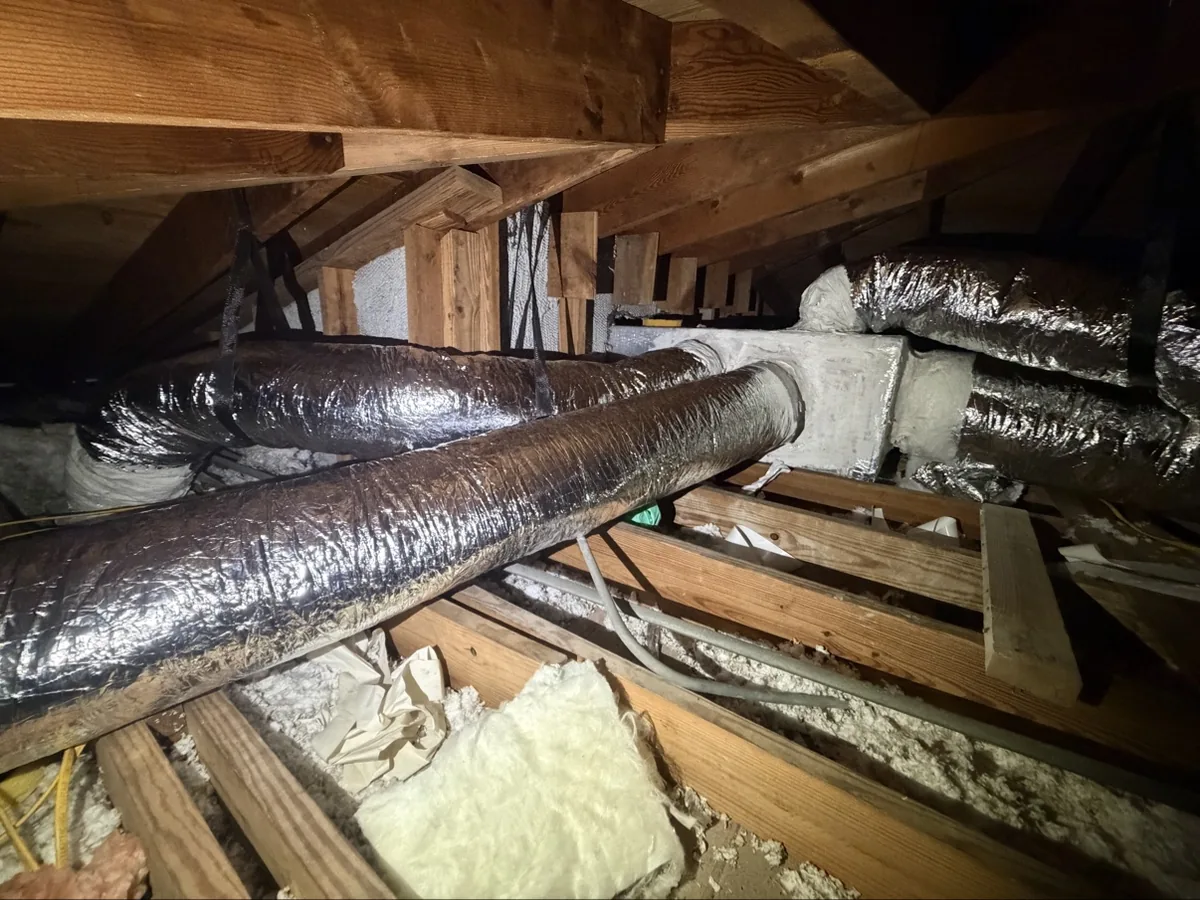
Flexible ductwork, which is standard in most South Florida homes, is built in three layers: an inner wire helix wrapped in plastic, a thick layer of fiberglass insulation, and an outer foil or plastic jacket called the vapor barrier. The vapor barrier has one job — keeping peak summer humidity away from the cold inner core — and it is relatively fragile. The failures we find, in order of how often we see them:
The order of the repair matters, and it is where cheap fixes go wrong. Seal the leaks before you wrap anything: run the fan, feel along joints, elbows and branch connections for escaping air, and seal what you find with UL 181M duct sealant or UL 181-rated foil tape — never cloth duct tape, which dries out and peels within a couple of seasons. Sealing first matters because insulation installed over an active leak only hides it. Then insulate to the right R-value with an intact vapor barrier: supply ducts in unconditioned space should carry roughly R-8, and returns at least R-6, with the foil facing doing as much work as the insulation itself. Tape every seam and overlap, and leave no bare metal at boots and elbows.
If the problem is caught early, targeted vapor barrier repairs and localized re-wrapping are often enough — not a full, expensive overhaul. But be honest about the cases where a repair is not enough: insulation that is saturated through should be removed and replaced, not dried and reused; ductwork torn in multiple places, or runs that are old R-4 or R-6 throughout, are usually better re-insulated or replaced outright. That is the judgment an inspection gives you, and it is what a free estimate is for: a technician in your attic, looking at your actual ductwork, telling you whether a repair will hold or whether the runs are done.
Duct re-insulation is quoted exactly on a free on-site estimate depending on how much ductwork is involved and how accessible the attic is. A full duct replacement is quoted exactly on a free on-site estimate for an average smaller residential home, varying with home sizing, layout and materials required. The right number for your house comes from the estimate, not from a chart — and what we quote is what you pay, with no hidden fees and no upselling. If a company tells you the whole system must be replaced before anyone has climbed into your attic, get a second opinion. The repair that stops the sweating is often far smaller than the replacement someone wants to sell you — and when it is not, an honest contractor will show you why, in your attic, with the ductwork in front of you.
Air Duct Specialists LLC serves Boca Raton and all of Palm Beach County. Licensed CAC1825166. Fully insured. 350 five-star reviews. Same-day service, 7 days a week, 7am–11pm. Free estimates — what we quote is what you pay.
📞 (561) 331-6777 — Palm BeachWhy is my ductwork sweating in the attic in Boca Raton?
Because cold supply air — around 50 to 55 degrees — runs through ducts sitting in a 130 to 150 degree attic. When the duct's insulation or vapor barrier fails, the outer surface drops below the dew point of the hot, humid attic air, and water condenses on it like a cold glass of iced tea. The water is not coming out of the duct; it is coming out of the air around it.
Is sweaty ductwork in the attic dangerous?
A little surface moisture on a humid day is common, but persistent sweating is not harmless. Water dripping from ducts soaks insulation, stains ceilings, swells joists and rusts strapping, and creates the damp conditions where mold and bacterial growth take hold inside the system. Wet insulation also loses its R-value, so the problem compounds — the wetter the insulation gets, the colder the duct surface becomes, and the more it sweats.
What causes duct insulation to fail in a West Boca attic?
The common causes: a torn or degraded vapor barrier from rodents, snags from other contractors working in the attic, or age; insulation compressed or slipped off the duct; older R-4 or R-6 ductwork that was never adequate for a South Florida attic; and air leaks at joints and boots that chill the outside of the duct below the dew point. Once the fiberglass underneath gets wet it loses thermal resistance, which makes the sweating worse.
Can sweating attic ducts be fixed without replacing them?
Often, yes — if it is caught early. Targeted vapor barrier repairs, re-wrapping failed insulation, and sealing leaking joints with UL 181M code-standards duct sealant can stop the sweating without a full replacement. But if the insulation is saturated through, the ductwork is torn in multiple places, or the runs are old R-4 or R-6 ductwork, re-insulation or replacement is the honest fix. An inspection tells you which one your house needs.
How much does duct re-insulation cost in Boca Raton?
Duct re-insulation and a full duct replacement for an average smaller residential home are both priced on a free on-site estimate, varying with home sizing, layout and materials. A free on-site estimate gives your exact figure — what we quote is what you pay.
What R-value should attic ductwork have in Boca Raton?
Supply ducts in unconditioned space should carry roughly R-8, and returns at least R-6, with a continuous vapor barrier facing that keeps humid air from reaching the cold surface underneath. R-value alone is not enough — the foil facing has to be continuous, seams taped, and no bare metal left at boots and elbows.