★★★★★
350
☰
A Palm Beach home looks immaculate — and it usually is. But the air inside it is a different story. Sealed tight against the heat, air conditioned nearly every day of the year, and served by ductwork running through a 140-degree attic, the average island home recirculates the same air thousands of times a day. What is in that air, and what your system does with it, decides how your household sleeps, breathes, and feels at home.
Indoor air quality in Palm Beach, FL is not an abstract wellness topic. It is a building-science problem with a very local shape. The island's homes share the same conditions: year-round cooling, tightly sealed envelopes, and outdoor air that carries salt, pollen, and humidity in heavy doses for most of the year. The air you breathe indoors is almost entirely the air your cooling system keeps recirculating — so the honest question is not whether your home has an air quality system. It does. It is your AC and your ductwork. The question is what condition that system is in.
Most homeowners notice the symptoms before they name the cause: dust that settles back a day after cleaning, a musty note when the system first kicks on, mornings that start with a stuffy nose. None of those is a single pollutant. All of them are the load your system is carrying — and returning to you.
The load comes from five directions at once, and Palm Beach stacks them higher than most places in the country:
Indoor air pollutants are often several times higher than outdoor levels, and in a sealed Florida home the gap is wider, not narrower. That is why the island's prettiest homes can carry the heaviest indoor load — the seal that keeps the heat out also keeps everything else in.
If one factor shapes Palm Beach indoor air more than any other, it is humidity. Most air quality guidance puts the target at about 40 to 55% relative humidity. Above that range, mold growth accelerates, dust mites multiply, musty odors develop, and the house feels sticky even at a comfortable temperature. Below it, the air dries skin and irritates throats — rarely the problem here.
Your air conditioner is the dehumidifier, and it only works when it runs long, steady cycles with full airflow across a clean coil. A system that short cycles because it is oversized, a coil choked with buildup, a filter denser than the blower can handle, or ducts leaking attic air into the return — any of these can leave a home cool but clammy, with humidity stuck in the 60s while the thermostat insists everything is fine.
A humidity problem calls for moisture control, not a bigger air conditioner. A bigger unit usually makes it worse: it cools the house faster and shuts off sooner, running even shorter cycles and pulling even less moisture out of the air. The fix is airflow, coil condition, and duct integrity — the system work, not the equipment size.
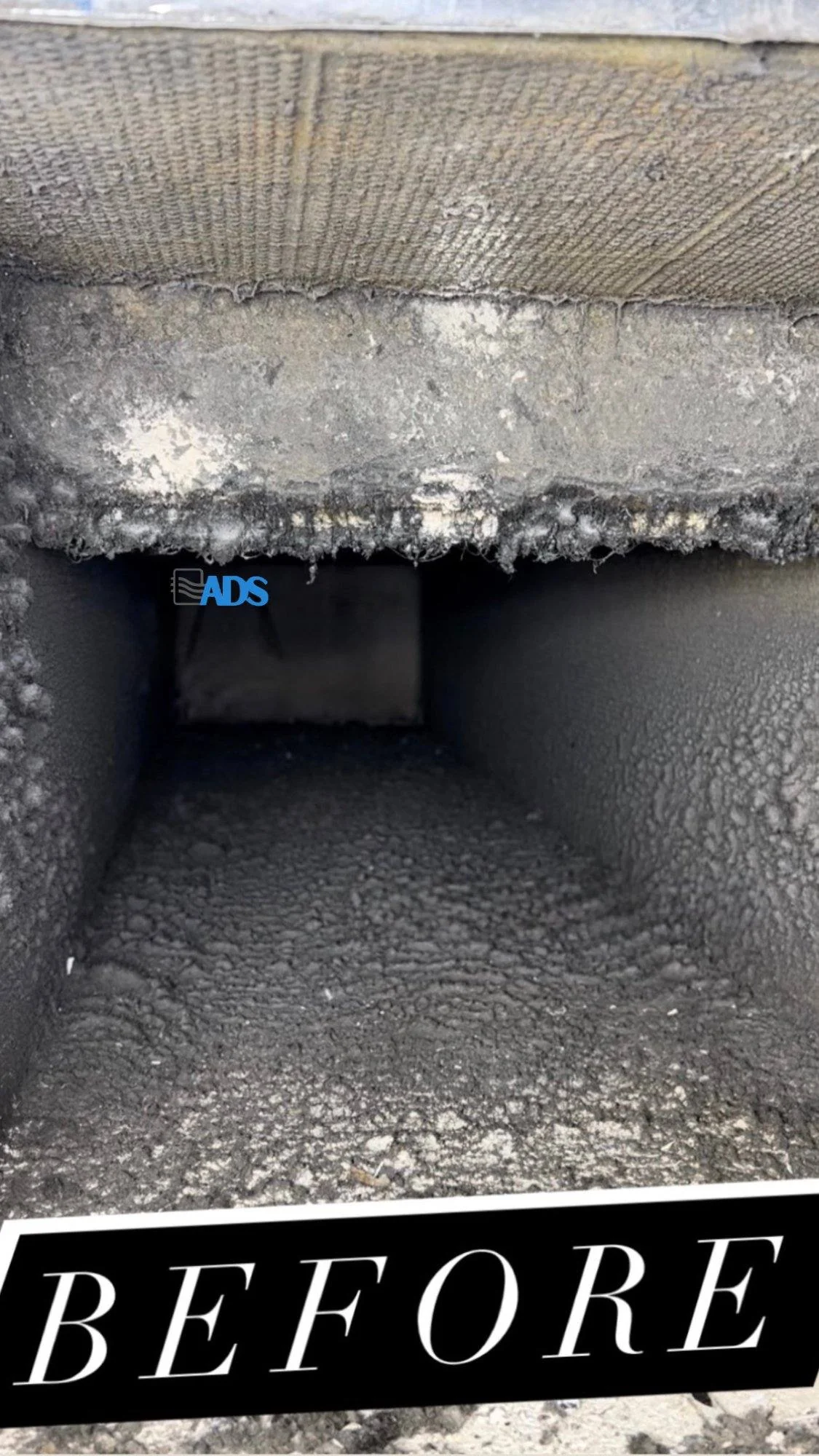
The EPA's guidance on improving indoor air quality starts with source control — removing contaminants from where they start — supported by ventilation and filtration. In a Palm Beach home, the source is usually the system itself. That is what a whole-system cleaning addresses, and it is why cleaning only the visible registers is like rinsing the faucet and leaving the pipes dirty.
A proper job covers the supply and return ducts, the registers and grilles, the evaporator coil, the blower wheel, and the drain pan — the whole path the air travels. It uses source removal: the system under continuous negative pressure with a high-powered vacuum, and agitation tools that physically break buildup loose from the duct walls so it is extracted, not pushed around. The EPA cautions against using biocides as a substitute for mechanical cleaning, and fogging or spraying chemicals without first removing the buildup The payoff is measurable in the house: airflow comes back, the coil can dehumidify again, and the musty note at startup fades — because the load was removed at its source, not masked.
An indoor air quality assessment is not a generic checklist. It looks at the specific conditions in your house — humidity levels, particulate and allergen load, signs of moisture, filtration effectiveness, and the state of the ductwork moving air through your rooms:
Whole-system air duct cleaning in South Florida is priced by the home — the number of systems, vents, and access all factor in. A Palm Beach estate with multiple systems and long attic runs is simply a different job than a small single-system home, which is why we don't publish a set price: call for a free estimate and an exact price before any work starts — what we quote is what you pay. If the inspection finds torn or leaking ducts, re-insulation and full duct replacement are likewise quoted on site, based on sizing, layout, and materials. We tell you honestly when a repair suffices and when it does not; that honesty is the brand.
What no gadget can do is replace that work. A plug-in purifier cleans one room while the central system recirculates the load through every other room. A scented spray masks an odor while the growth that causes it keeps spreading. The hierarchy is simple and it has not changed: remove the source, keep the air moving, filter what remains. Everything else is an extra, not a substitute.
Air Duct Specialists LLC serves Palm Beach and all of Palm Beach County. Licensed CAC1825166. Fully insured. 350 five-star reviews. Same-day service, 7 days a week, 7am–11pm. Free estimates — what we quote is what you pay.
📞 (561) 331-6777 — Palm BeachWhat hurts indoor air quality most in a Palm Beach home?
Humidity, first. A Palm Beach home stays sealed and air conditioned nearly all year, so whatever gets inside — dust, pollen, pet dander, cooking particles, cleaning chemicals, salt air — keeps recirculating. High indoor humidity then feeds mold, mildew and dust mites, which are the most potent indoor triggers for allergies and breathing trouble.
Does duct cleaning actually improve indoor air quality?
When the ducts are genuinely contaminated, yes. The EPA treats source control — physically removing contaminants where they start — as one of the three pillars of healthier indoor air, alongside ventilation and filtration. A whole-system cleaning that removes dust, debris and growth from the ducts, coil and blower changes what the air carries every time the system runs.
What indoor humidity should a Palm Beach home hold?
Most air quality guidance puts the target at about 40 to 55% relative humidity. Above that range, mold growth accelerates and dust mites multiply; the house also feels sticky even at a comfortable temperature. A system that cannot hold humidity in range usually has an airflow, coil or sizing problem, not a thermostat problem.
Will a plug-in air purifier fix my home's air quality?
A portable purifier helps in one room, but it cannot fix what the central system keeps recirculating through every room. If the ducts, coil and blower are loaded with dust and growth, the system re-seeds the air faster than a room unit can clean it. Fix the source first, then a room purifier is a useful extra.
How often should a Palm Beach home have its ducts cleaned?
For most large South Florida homes, a whole-system cleaning every 3 to 5 years is reasonable — sooner with pets, frequent remodeling, heavy year-round AC use, or visible contamination. The right schedule comes from inspecting your specific system, not a fixed calendar rule.
Are you licensed and insured?
Yes — Air Duct Specialists LLC is a licensed Florida air conditioning contractor, license CAC1825166, and fully insured. You or your property manager can verify the license through the Florida DBPR before any work begins.