★★★★★
350
☰
On a Southwest Ranches estate, the rooms closest to the air handler can feel fine while a bedroom wing, guest house, or pool house on the other side of the property never catches up. That gap is rarely a thermostat problem. Out here, cooled air often has 60 to 100 feet of duct to travel — and if it is leaking along the way, the far end of the house pays for it.
Air duct leaks in Southwest Ranches, FL follow a simple rule: the longer the run, the more places there are for air to get out. Federal energy guidance puts typical duct losses at roughly a fifth to nearly a third of the air a system moves, and long attic systems can lose more. On a one- or two-acre estate in horse-country Broward, that lost air is not a minor inefficiency. It is cooled air dumped into a 130- to 150-degree attic, hour after hour, while the rooms at the end of the line stay warm.
Southwest Ranches, ZIP 33330, is built differently from the rest of Broward. Lots run an acre or more. Homes spread out instead of up — long single-story wings, a detached guest house, a pool house with its own vents, sometimes a barn converted to an office or studio. Each of those spaces needs air delivered across real distance, often through a wide, hot attic. A compact suburban home might have a handful of duct connections. An estate system can have dozens, and every elbow, takeoff, and junction is one more seam that heat, age, and attic traffic can work loose.
Think of a duct run as a garden hose with fittings along its length. A small drip near the spigot barely matters. Ten small drips spread over a hundred feet, and very little water reaches the far end. Ducts work the same way, except the loss compounds: air that escapes early never builds pressure downstream, so a modest leak 70 feet from the handler can starve the last vents on that branch almost completely.
Multiple structures make it worse. Guest houses and pool houses are often fed by extended runs or separate branches that sit in the attic the longest, so they pick up the most heat and suffer the most leakage. Converted spaces add another wrinkle — a former barn or garage office was rarely ducted to the same standard as the main house, and its connections are often the first to fail.
Then there is the volume problem. Big custom homes mean big attic volume, and every bit of cooled air that leaks into that attic is air the system has to replace. Owners end up cooling a huge, empty space above the ceiling while the living space below — especially the far wing — never quite gets there. That distance effect is what makes air duct leaks in Southwest Ranches, FL a different problem from a leak in a small, tight floor plan.
Leaks announce themselves quietly at first. These are the patterns we hear about most on estate properties:
Sun exposure can make one room warmer in the late afternoon, and a closed vent can mimic a weak branch. Neither explains a room that is behind at 9 a.m., behind at noon, and behind again the next day. Consistency is the giveaway — a leak does not take days off.
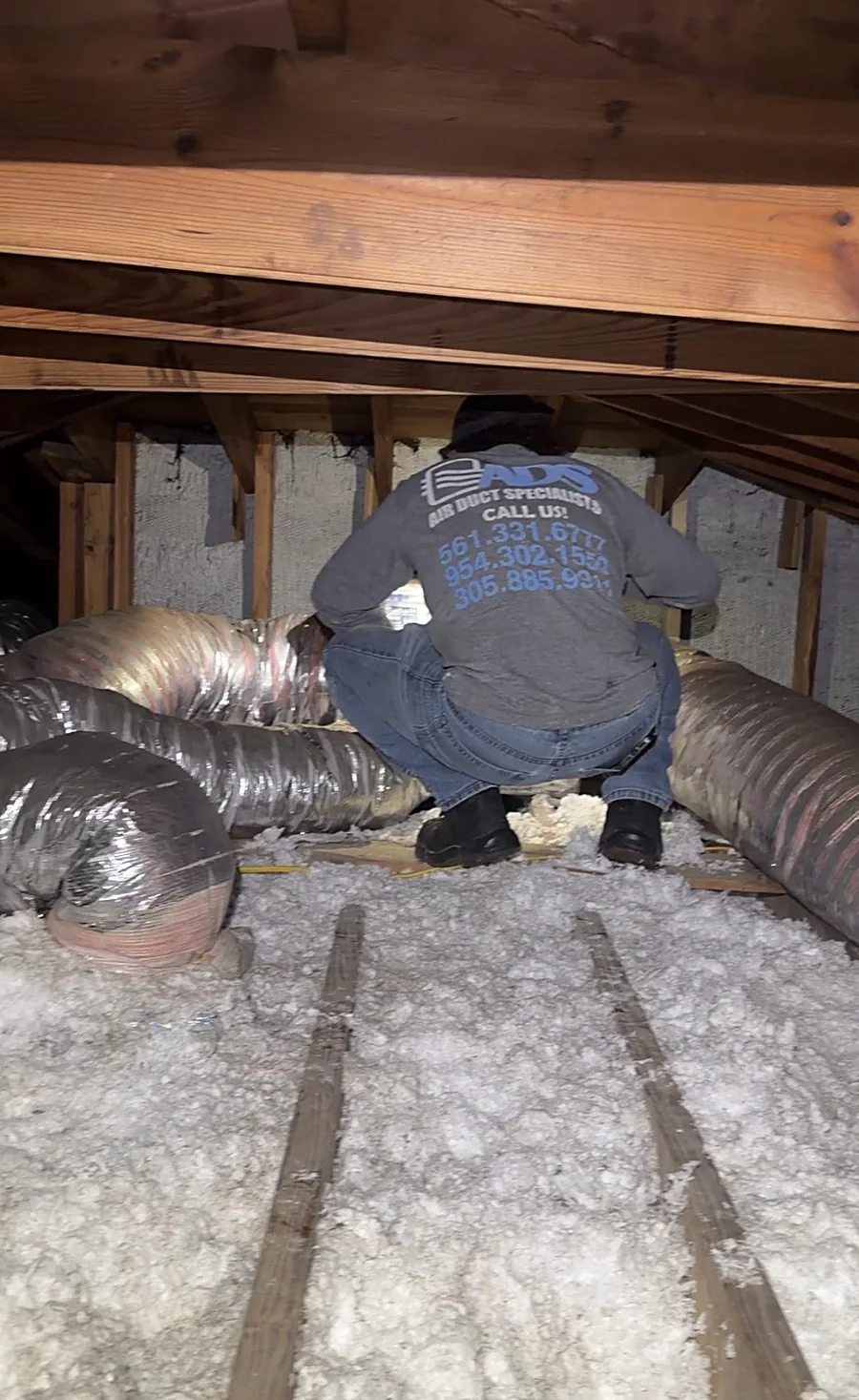
You can cover the basics without any special tools. Set the fan to run, then head into the attic early in the morning, before the heat builds, with a flashlight. Work from the air handler outward along each main branch. Pass your hand slowly over seams, takeoffs, and connections at the plenum — escaping supply air feels like a cool jet, while a return leak feels like it is pulling at your skin. A thin strip of tissue held near a joint will flutter or lean toward a leak you cannot feel.
Also look, do not just feel. Peeling tape, grey dust streaks fanning out from a seam, sagging flex, and sections that have pulled partly off their collars all mark spots where air has been getting out. On a 60- to 100-foot run there can be several. When the accessible ductwork looks sound but a wing still lags, or when you want a number instead of a guess, a professional duct leakage test pressurizes the sealed system and measures the loss directly — including leaks hidden above ceilings and inside walls that no attic walk will find.
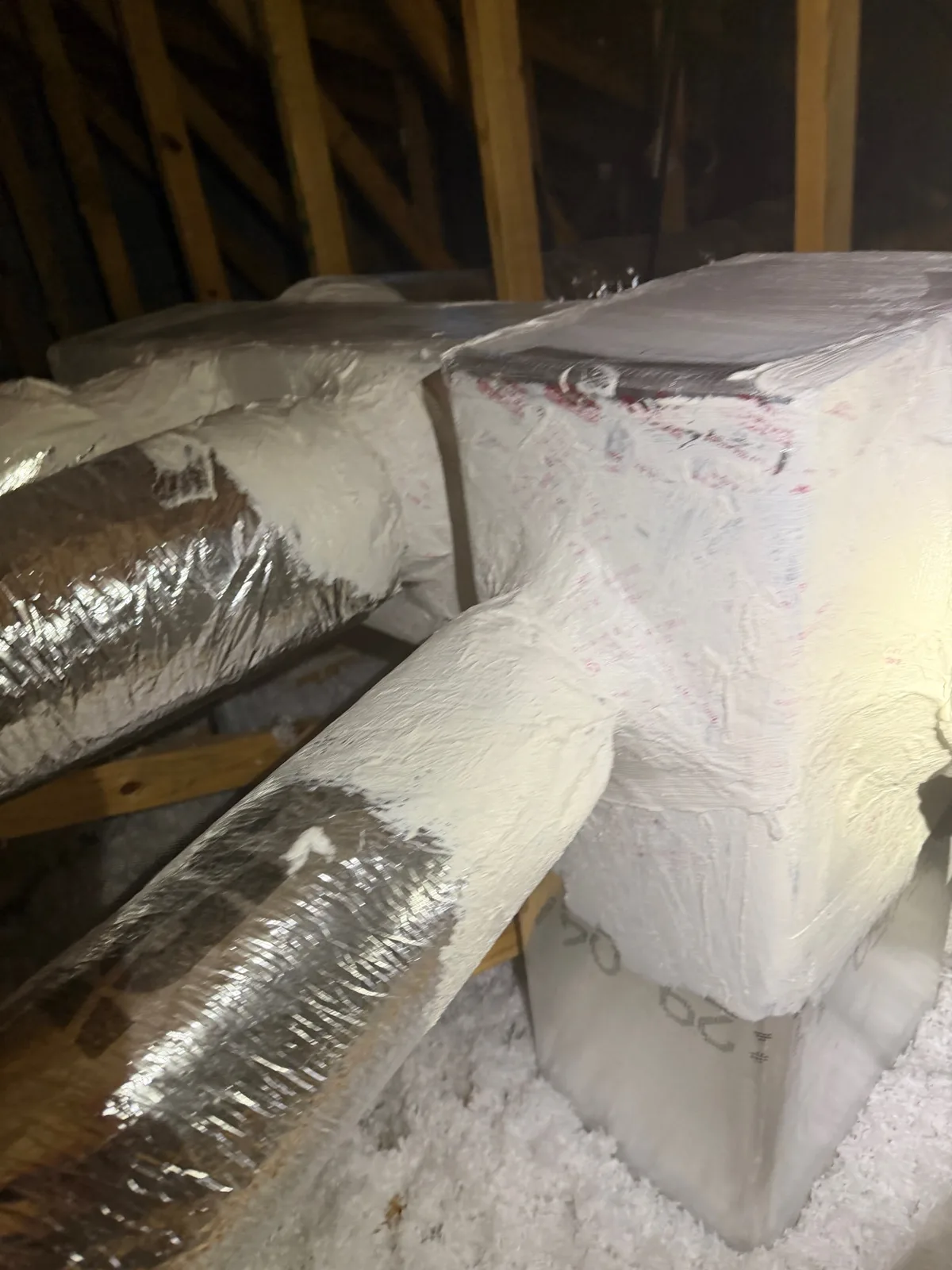
Proper sealing is unglamorous, methodical work, and on a long estate run there is simply more of it. Our techs start at the air handler and the plenum, where pressure is highest and leaks cost the most, then work outward along every branch — each elbow, takeoff, and junction box brushed with UL 181M code-standards duct sealant. Narrow gaps take UL 181M code-standards duct sealant on its own. Wider ones get fiberglass mesh pressed into a first coat and sealed over with a second, so the repair flexes with the duct instead of cracking away from it.
What does not hold is the fix most attics already have: cloth duct tape. Its adhesive gives up under attic heat and repeated pressure cycles, which is why we so often find it hanging off the very joints it was meant to seal. UL 181M code-standards duct sealant cures into a flexible, durable skin that stays put for years, and on smooth metal seams UL 181 foil tape does the same job.
Sealing and insulation go together. A tight joint wrapped in failed, paper-thin insulation still loses cooling to the attic on a long run, so damaged insulation gets addressed while the system is open. And because leaking returns drag attic dust across the coil for years, we check the coil and blower during the same visit — sealing the ducts stops new dust coming in, and cleaning what is already there lets the system breathe the way it should.
For sound ductwork with failed joints, sealing is money well spent: the materials are modest, the labor is straightforward, and the improvement shows up in the far rooms and on the next electric bill. We price it from a free on-site estimate, because on an estate property the honest variable is scope — how many branches, how many structures, and how much of the run we can reach.
We will also tell you plainly when sealing is not the answer. Ducts that are torn, crushed, sagging between supports, or wrapped in insulation that has lost its value need more than UL 181M code-standards duct sealant. Duct re-insulation and a full duct replacement are both quoted on a free on-site estimate; replacement for an average smaller residential home varies on home sizing, layout, and materials required — and estate-sized systems, with longer runs and multiple structures, are priced by that same free estimate so the quote reflects your property, not an average. What we quote is what you pay.
Air Duct Specialists LLC serves Southwest Ranches and all of Broward County. Licensed CAC1825166. Fully insured. 350 five-star reviews. Same-day service, 7 days a week, 7am–11pm. Free estimates — what we quote is what you pay.
📞 (954) 302-1550 — BrowardWhy do duct leaks hit Southwest Ranches estate homes harder?
Distance. Many Southwest Ranches homes run ducts 60 to 100 feet or more from the air handler to the far wings, guest houses, and pool houses. Every extra foot adds joints and connections, and every joint is a place air can escape. A leak near the end of a long run can leave that wing short on cooled air even when the equipment itself is working fine.
What are the signs my air ducts are leaking?
One wing or outbuilding that never quite cools, weak airflow from the farthest vents, rising electric bills, dust building up around registers, a faint hiss near duct joints, and a system that runs longer than it used to. The key pattern is consistency — the same rooms lag behind at every thermostat setting.
How are duct leaks found on a long estate run?
Start with what you can reach: run the fan, feel along seams and connections for escaping air, and hold a tissue strip near joints to see if it flutters. Look for peeling tape, dust streaks, and partly disconnected sections. For a measured result, a professional duct leakage test pressurizes the system and reports how much air is being lost.
How are leaking air ducts sealed?
Accessible joints are sealed with UL 181M code-standards duct sealant, a brush-on sealant that stays flexible as it cures, with fiberglass mesh worked in for larger gaps. Smooth metal seams can also take UL 181 foil tape. Ordinary cloth duct tape is not the fix — heat and pressure cycles loosen its adhesive until it lets go.
Do leaky ducts affect the air inside the house?
Yes. A supply leak dumps cooled air into the attic, while a return leak pulls hot attic air — along with dust, insulation fibers, and humidity — back into the system and out through your vents. Sealing the return side is often where owners notice the biggest improvement in both comfort and air quality.
Are you licensed and insured?
Yes — Air Duct Specialists LLC is a licensed Florida air conditioning contractor, license CAC1825166, and fully insured. You can verify the license through the Florida DBPR before any work begins.