★★★★★
300
☰
Most articles on this subject are written by people who have never held the equipment. This one is not. Here is what a proper air duct cleaning involves, photographed on a recent estate job in Boca Raton.
There is a lot of published material about air duct cleaning, and most of it is vague in the same way — long on why you should be worried, short on what anyone actually does. We get handed printouts of it on jobs. So this article does the opposite: it walks through the physical process, names the equipment, and shows what it looks like in a real house.
Worth saying up front, because it costs us work: duct cleaning is not something every home needs on a schedule. The EPA's position is that it has not been shown to prevent health problems, and we agree with them. What it does do — when there is genuine debris in the system — is remove that debris and restore airflow. That is the honest claim, and it is the one we make.
Professional duct cleaning works on a principle called source removal, and it has two halves that only work together. The first is negative pressure: a high-capacity collection unit is connected to the duct system near the air handler, and every supply and return in the house is sealed. That turns your ductwork into a closed system with airflow moving in exactly one direction — toward the collection unit.
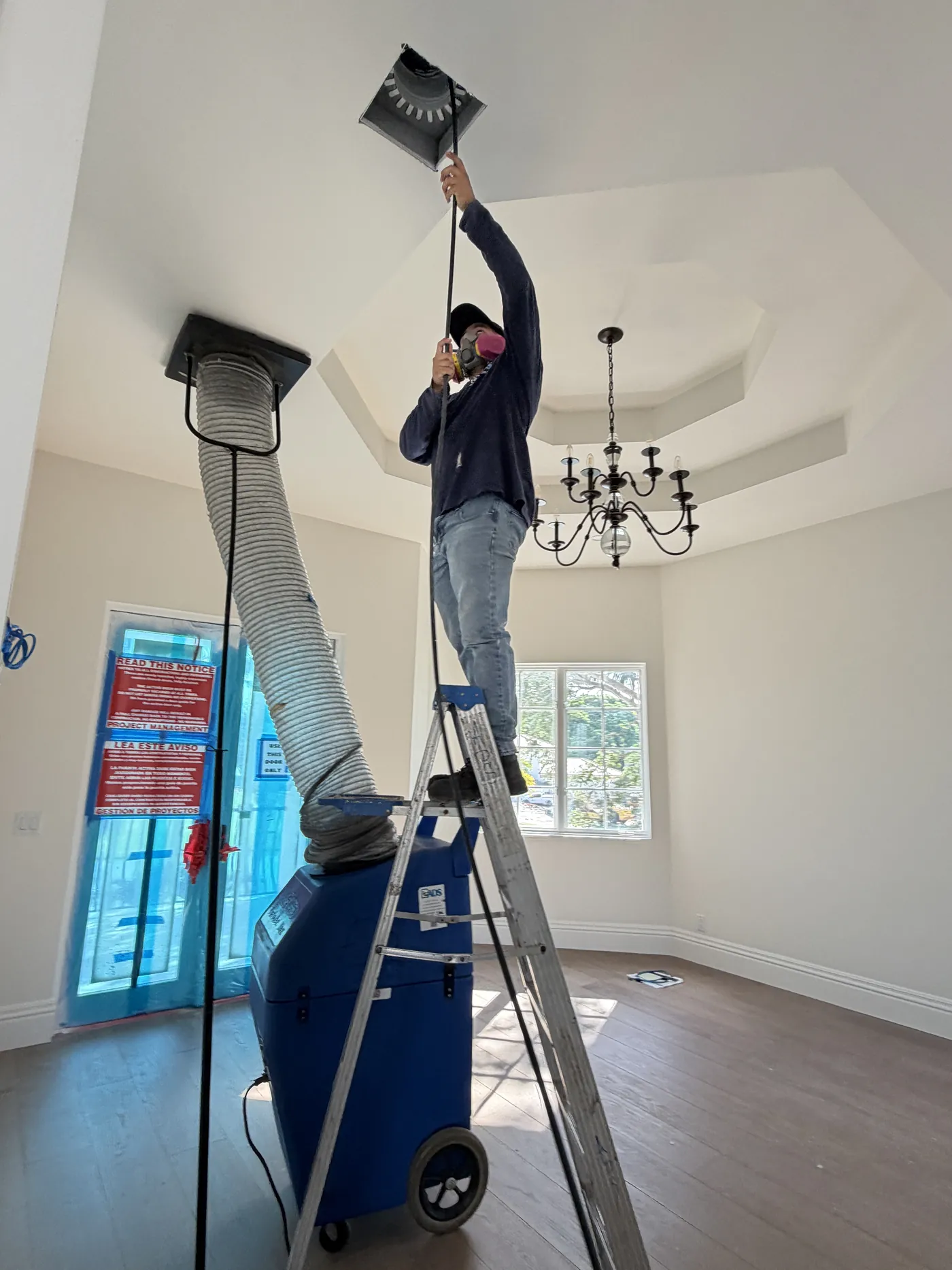
The second half is agitation. Nothing comes off duct walls from suction alone. A technician works each run mechanically — compressed air whips, rotary brushes, skipper balls — making physical contact with interior surfaces so buildup breaks loose. The negative pressure then carries it away rather than letting it settle somewhere else in the house.
Take either half away and the job fails. Agitation without vacuum is a blow-out — debris gets pushed deeper into the system and eventually out of your registers. Vacuum without agitation pulls loose surface dust and leaves everything bonded to the walls. And chemical fogging without mechanical cleaning first is not cleaning at all; the EPA specifically cautions against using biocides as a substitute for physical removal.
One question worth asking any company
"Do you seal every register and run negative pressure, and do you agitate each run individually?" The answer tells you almost everything. A crew that arrives with a shop vacuum and no containment is not doing this.
Before equipment comes off the truck, the system gets inspected and photographed. We are looking for physical damage — crushed flex, disconnected branches at the plenum, tape and mastic failing at elbows and supply-return transitions. In South Florida we are also looking for moisture: sagging insulation, staining around boots, anything suggesting condensation inside the run.
This matters for a practical reason. If a duct is torn or disconnected, cleaning it is the wrong job — it needs sealing and repair first, and cleaning a system that leaks into the attic just re-fills it. Photographs from this stage are also what you compare against afterward. Without them, "it looks cleaner" is an opinion.
Every register and return gets sealed. The collection unit connects to the trunk line through an access point near the air handler and stays outside or in the garage, so nothing it captures ends up back in the house. Portable machines generate somewhere around 5 inches of water column of negative pressure; truck-mounted systems considerably more.
On the estate job in these photographs the entry doors were sheeted in plastic before anyone brought a ladder inside. That is not an aesthetic choice — travertine, plaster columns and finished millwork are unforgiving of a dropped register cover, and containment is as much about protecting the house as controlling dust.
This is the part that takes the hours. A technician works from each register inward, agitating the full length of the run. Rigid sheet metal takes rotary brushes. Flex duct and fiberglass-lined systems take softer air whips, because a brush will tear the liner and turn a cleaning into a replacement.
Every supply gets five to ten minutes of individual attention. Branch runs are done before trunk lines, so debris moves in the right direction. In a normal South Florida house that is fifteen to twenty registers. In an estate home with three zones and twenty-foot ceilings, it is considerably more — and every one of them needs a ladder.
Cleaning ducts and leaving the air handler alone is the single most common shortcut in this industry, and it undoes the whole job. The evaporator coil and blower wheel are downstream of everything. If they are fouled, the system re-contaminates the ducts you just cleaned the first time it cycles.
On the Boca Raton job the coils came out of the units entirely and were cleaned outside. That is not always necessary — plenty of coils can be cleaned in place — but when buildup is heavy enough, pulling the coil is the only way to reach the back side of the fins. A coil cleaned from one face only is a coil half cleaned.
The blower wheel gets the same treatment: each fin worked individually, on the concave face where debris packs in. A loaded blower wheel is one of the most common causes of weak airflow we find, and it is invisible from outside the cabinet. Drain pan and line get flushed at the same time, because a system that has been running dirty usually has a drain starting to slime up.
The industry standard for a finished job is a visually clean criterion — no visible debris remaining. That is verified by inspection, not by someone telling you it went well. Registers go back in the positions they came out of, a fresh filter goes in, and the system gets run and checked.
We photograph before and after on every job. Partly because it is the only honest way to show what changed, and partly because on a house like the one in these pictures, the homeowner is not going up a twenty-foot ladder to check.
Most national articles about duct cleaning are written for a seasonal climate. Ours is not one. A system here runs close to year-round, which is roughly triple the operating hours a northern system sees. Humidity sits above 70% for much of the year, so the evaporator coil stays wet — and a wet coil is exactly what dust needs to bond to aluminium fins rather than pass through.
Coastal properties add salt to that. Condenser coils along the Intracoastal and Biscayne Bay corrode measurably faster than inland equipment in Weston or Miramar. None of that changes the cleaning process, but it changes how often the question is worth asking — and it is why we lean harder on annual maintenance here than a manufacturer's schedule written for Ohio would suggest.
A typical single-system South Florida home takes three to five hours. Large estate homes with multiple air handlers and two or three zones run considerably longer — the Boca Raton job pictured in this article took the better part of a day across multiple systems. Anyone quoting under two hours for a whole house is not doing the work described here.
Not on a fixed schedule, and we will tell you if you do not. The situations that genuinely justify it are visible debris or dust discharge from registers, post-construction or renovation dust, pest or rodent evidence, water intrusion in the system, or taking over a house whose history you do not know. If you change filters regularly and see none of those, your money is usually better spent on coil cleaning and a maintenance visit.
Source removal means negative pressure on the system plus mechanical agitation inside every run, so debris is carried into a sealed collection unit. Vacuuming a register cleans the first few feet you can see. A blow-out with compressed air and no vacuum simply relocates debris deeper into the system. Only one of the three actually removes anything from the house.
It should. Cleaning ducts while leaving a fouled evaporator coil and blower wheel in place guarantees the system re-contaminates itself the moment it runs. On the Boca Raton estate shown here we pulled the coils entirely for cleaning. If a quote covers ducts only, ask what happens at the air handler.
Yes — every room with a supply register or return. Each one gets sealed and worked individually. They do not all need to be open at once, so pets can be confined to a finished area while work moves through the house.
It depends on the number of systems, the number of registers, and the condition of the equipment — which is why we quote on site rather than over the phone. Be cautious with advertised flat rates well under a couple hundred dollars; that pricing does not cover the labour described in this article, and the number typically changes once someone is in your house.
We will look at your system and tell you straight — including when the answer is no. Free estimates across Miami-Dade, Broward and Palm Beach.
📞 (954) 302-1550 📋 Request a Free EstimateHow Often Should Air Ducts Be Cleaned?
The triggers that matter more than a calendar
Evaporator Coil Cleaning Miami & Broward
Why the coil matters more than the ducts
Air Duct Cleaning Cost in Miami & Broward
What changes the price, and what the $99 offers leave out
Why Cleaning Ducts Alone Doesn't Work
The coil and blower decide the result
Estate Home Air Duct Cleaning
Multi-zone systems and long runs